The age of contribution
Festival highlights social value of senior citizens, Cheng Yuezhu reports.










Often deemed "the coolest grandma" in China, she says she has only one trick up her sleeve. "It's that I'm not afraid to wipe the slate clean. I have, time and again, had to start over in life," she says. "Though I'm 70 now, I feel that I'm just getting started."
The 2021 Luminous Festival was hosted in Beijing by cultural and art organization Body On&On and the Beijing-based Philanthropreneur Foundation from Sept 1 to 7.
With a consistent focus on inclusive arts, this year the festival was themed minbaowuyu, a Chinese idiom meaning "all people are brothers and sisters and all things are equal", advocating equality, tolerance and empathy for all living beings.
Ge Huichao, founder of Body On&On and the festival, says the forum's theme on aging comes from the findings of China's seventh national population census last year, and that the experts were invited to highlight the creative responses to the challenges and changes posed by aging.
According to the census, the number of people aged 60 and above in China has exceeded 260 million, accounting for 18.7 percent of China's total population. Specifically, those aged 65 number more than 190 million, 13.5 percent of the population, making aging an important issue.
Liang Chunxiao, founder of the forum's co-organizer the Pangoal Institution Aging Society Studies Center, proposes attention to "the third life stage". He refers to the period from being born to entering one's career as the "first life stage", and work to retirement as the second.
"In the past, people's life journey comprised mostly only the first two stages," Liang says. "But now, many people, after their retirement at around 60, can live healthily for 20 years or longer. It's not a time for people to passively wait for the inevitable end, but the beginning of a new life stage."
According to Liang, as an increasing number of retirees actively seek to enrich their lives, healthcare is only one of the issues to focus on, and the whole society needs to advance to adapt to the needs of the elderly, including infrastructure and policy.
"In this process, we particularly need societal innovation, which requires us to think outside the box and merge the expertise from different fields in order to spark the imagination. Art is the best approach to break through the limitations and expand our thinking," Liang says.
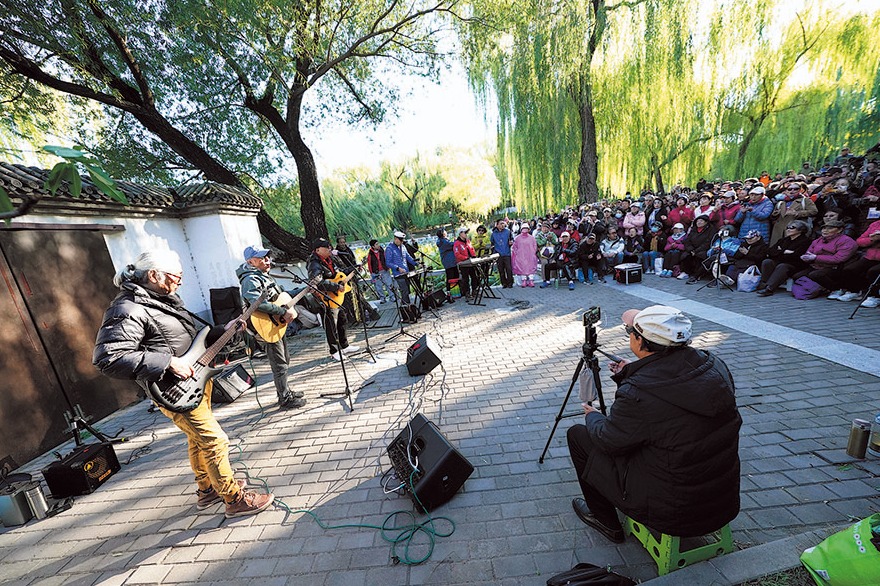
At the forum, several art and cultural practitioners shared their experiences of community work that aims to enrich the lives of the elderly through a diverse range of art forms.
Playwright Li Yingning, 79, has had more than 20 years of experience in theater education, mostly for teenagers. In 2005, she opened up a theater workshop in Shanghai for a group of retirees, helping them to recount the ups and downs in their lives and explore their personal values.
Three years ago, she settled down in suburban Hangzhou, Zhejiang province, thinking she could retire and enjoy some peace.
Most of the residents in her community are senior citizens just like herself, with a pleasant environment and adequate infrastructure suited to their everyday needs. But Li soon detected a sense of ennui facing many residents caused by a lack of cultural activities.
Li, therefore, called on her fellow senior citizens to set up societies covering a wide range of cultural activities that serve to enrich their lives. The residents can choose the activities to their liking, whether it be theater, singing, dancing, painting, photography or sport.
"We encourage our participants to exercise their imagination, jump out of their comfort zones and learn new things they have no experience in," Li says.
"It's not all about learning new skills, not about proving their achievements by giving a public performance or having their work displayed in an exhibition. What is important is to enhance their overall abilities by practicing art."
As the societies became increasingly popular, Li also started several activities for children and teenagers, such as English reading, with the vision of establishing a rich cultural environment inclusive of all age groups.
With her own experiences, Li advocates lifelong learning-she started to promote theater education in China after the age of 50, started learning English at 56, and started her own business at almost 60.
While the elderly require healthcare, she says they also need to learn and to achieve in order to find a sense of contentment and self-actualization, which is equally important, if not more so.
Contact the writer at chengyuezhu@chinadaily.com.cn