



Central banks up reserves of RMB to a high









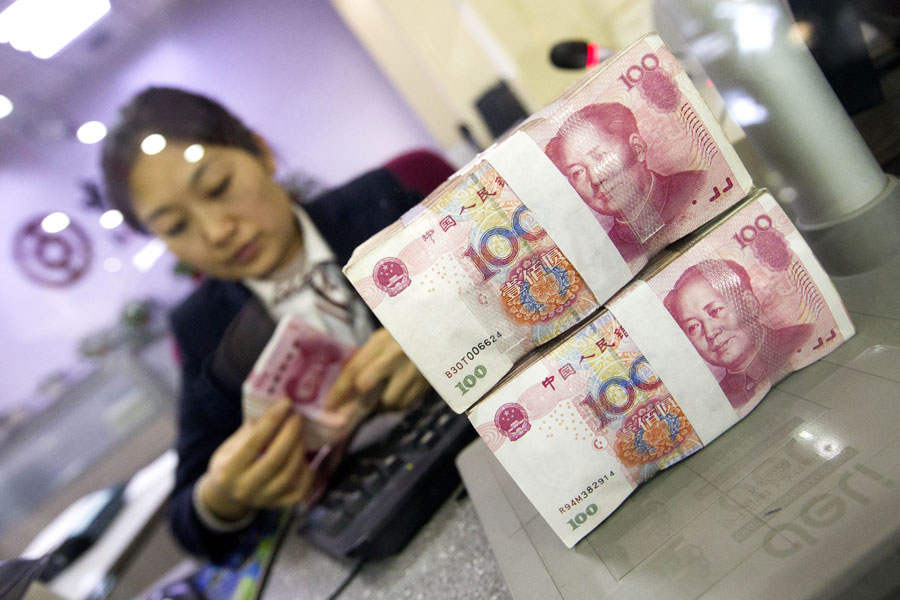
5-year record shows Chinese yuan's internationalization progressing well
Central banks around the world are holding record levels of reserves in Chinese yuan, according to IMF data.
Analysts said the current five-year high marks another step forward for the Chinese currency's internationalization, a process that began a few years back.
In the first quarter this year, various central banks held $287.46 billion worth of Chinese RMB in official foreign exchange reserves, the highest level since the fourth quarter of 2016 and representing 2.45 percent of the total, the International Monetary Fund reported on Wednesday.
Typically, central banks hold foreign exchange reserves in leading currencies such as the US dollar, the pound sterling, the euro and the Japanese yen.
It was in 2016 that the IMF included the RMB in its Special Drawing Rights or SDR basket for the first time. The volume of RMB in the IMF's Currency Composition of Official Foreign Exchange Reserves, or COFER, has increased for nine consecutive quarters, the IMF said.
Analysts said that reflects improvement in the RMB's status as an international currency, which is playing a more important role in the global economy.
A substantial increase in the volume of yuan-denominated claims in the IMF's COFER database has shown the widespread adoption of the Chinese RMB as a global reserve currency, according to a research note from Fitch Ratings.
The US dollar had the largest 59.54 percent share of global foreign exchange reserves in the first quarter, followed by the euro (20.57 percent) and the Japanese yen (5.89 percent), IMF data showed.
"If China's economy can sustain medium- to high-speed growth, and the financial market's liquidity and resilience could be strengthened, without any systemic financial crisis, then, the RMB may become the third-largest international currency by 2035," said Zhang Ming, deputy head of the Institute of Finance and Banking at the Chinese Academy of Social Sciences, or CASS.
Zhang predicted that the RMB, used for payments, trading and reserves, will surpass the British pound sterling and the Japanese yen in another decade, ranking third after the US dollar and the euro.
The major factor that can influence the currency composition of central banks' reserve portfolios is exchange rate fluctuations, said Serkan Arslanalp, deputy division chief in the Balance of Payments Division of the IMF's Statistics Department.
Other factors include changes in the relative values of different government securities.
The RMB appreciated by more than 1.2 percent against the US dollar in the first half of this year, amid US dollar weakness against major currencies.
The Chinese yuan's appreciation against the US dollar was partly due to higher foreign portfolio inflows, Fitch said.
Economists predicted that in coming months, China's goods exports may weaken, as reopening of developed market economies will likely shift their consumption back to services.
That could lead to a narrowing of the current account surplus and slower appreciation, or even depreciation, of the RMB.
"Beijing is expected to implement measures, if necessary, to limit RMB appreciation," said Lu Ting, chief economist in China for Nomura Securities.
The US dollar's share of global reserves in the first three months slightly rebounded to 59.54 percent from 58.94 percent-its lowest level in 25 years-in the fourth quarter of 2020, IMF data showed. But it still remains the dominant international reserve currency.
Significant fluctuations in the interim, as well as active buying and selling decisions of central banks to support their own currencies, may have led to short-term variance of the US dollar's share in global reserves in the past, said Arslanalp of the IMF.
However, taking an even longer-term view of the past, the decline of the US dollar's share in global reserves is unmistakable, and indicates that central banks have indeed been shifting gradually away from the greenback, Arslanalp added.
Some analysts said as central banks in emerging markets and developing economies seek to further diversify the currency composition of their reserves, the US dollar's share will continue to fall.




















