Mountains echo to sound of revolutionary fervor









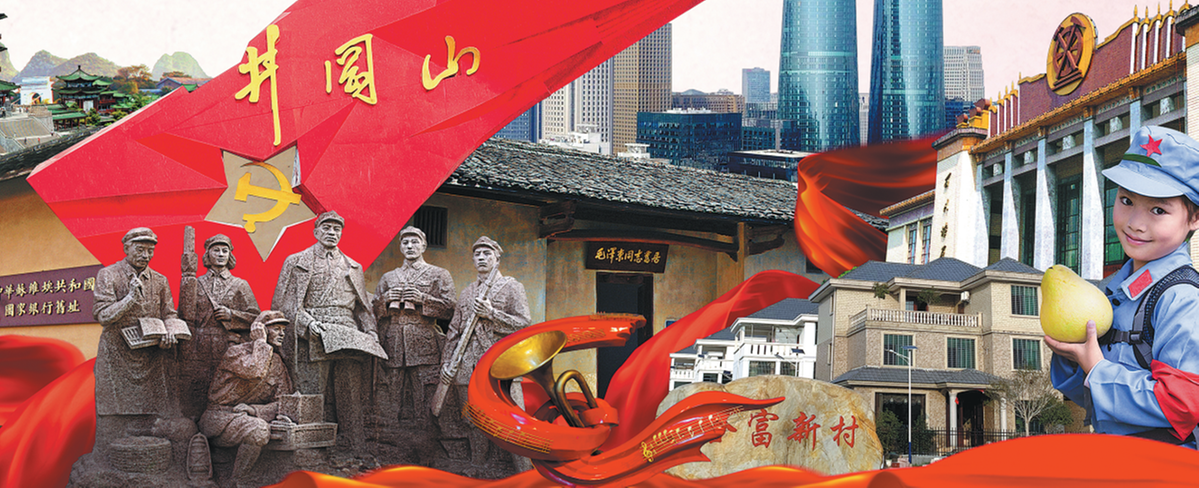
Former CPC and Red Army strongholds are drawing large numbers of visitors keen to follow in the footsteps of history
Dressed in replica Red Army uniforms, groups of teenage tourists walked along a rugged path in the Jinggang Mountains, Jiangxi province.
The path was part of a route used by the Red Army, a forerunner of the People's Liberation Army, to carry daily supplies up the mountain when the force was based in the area in the 1920s.
As part of a popular tourist program to experience the life of a Red Army soldier, visitors laden with rifles and sacks of food have to complete several tasks along the 5-kilometer trail, including finding herbs.
They can also cook a meal in local people's kitchens to get a taste of the soldiers' diet, which mainly consisted of foods such as pumpkins and corn, before ending the day with a chorus of revolutionary songs featuring inspiring lyrics and melodies.
As the 100th anniversary of the Communist Party of China approaches, tourists are flocking to the mountain range, known as the "cradle of the Chinese revolution", to learn about the Party's history and retrace the footsteps of the revolutionary generation.
During the recent May Day holiday, the number of tourists who visited Red Tourism sites in Jiangxi rose by 300 percent year-on-year, while attractions in the Jinggang Mountains were swamped with visitors, according to the local government.
"People from all over the country come here. It's the eternal spiritual home and the highland of faith in the mind of the nation," said Jiao Xuejun, mayor of Jinggangshan, a city nestled deep in the mountains.
"They feel encouraged to overcome life's difficulties after learning what our revolutionary ancestors sacrificed for their ideals and beliefs," he said, adding that this year's travel season is just beginning, so he expects to see many more tourists arrive.
Red Tourism
Jinggangshan, located in a remote location near Jiangxi's border with Hunan province, was an ideal base for the CPC and the Red Army in the 1920s, but its topography and isolation resulted in local people becoming impoverished in more recent times.
After landing at Jinggangshan Airport and driving for an hour through green forests occasionally dotted with houses and fields, visitors reach the Jinggangshan Revolution Museum, a must-see venue in the center of the town.
The mountains seem like a huge museum without walls, with 120 old sites where the revolutionary generation lived and fought. They are also home to many relics that record the Party's history during the period.
In recent years, Jinggangshan has made good use of its historical resources to design courses that promote the red education industry, which is focused on understanding the Party's history and theories.
Mao Haofu gives engaging English-language tours and lectures at historical sites to visitors from overseas.
In 2016, the 32-year-old quit his job in a bank in Nanchang, Jiangxi's capital, and returned to his hometown to make use of his language skills and tell stories related to local Party history.
He made the decision after seeing a special New Year's greeting card in the museum. The card had been written in English by a Red Army soldier to his fiancee. Mao, who has a master's in finance from the University of Hull in the United Kingdom, was surprised that a Chinese person could write English at that time.
"I was picky. I checked to see if there were any grammar or spelling mistakes, but the beautiful writing showed that the writer must have been an educated person," he said.
He later discovered that during revolutionary times many 20-something university graduates, including some who had studied overseas, came to the mountains. Many sacrificed their lives.
"Those young people didn't work in big cities; they joined the revolution and shouldered their responsibilities, which moved me a lot. Through that greeting card, I had a spiritual dialogue with the martyr," he said, noting that the young man died in battle.
"I am confident about telling the history of the Chinese revolution to people from all over the world. By carrying on this legacy, we have achieved a great deal in the new era."




- Beijing witnesses snowfall
- Tongji University's Wu Jiang assumes presidency of architects' Asia council
- PLA carries out drone training operations near Dongsha Islands
- PLA monitors US naval vessels transiting the Taiwan Strait
- Losar warmth in a new home
- New carrier rocket built by Beijing company fails in maiden flight