Experts question safety of Japan's wastewater plan









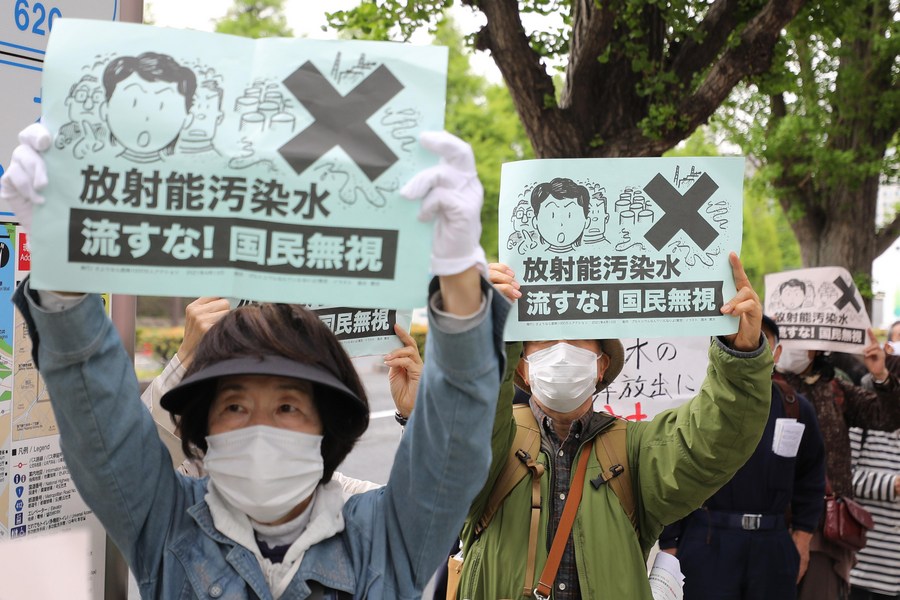
Some scientists are challenging the claim by Japan that it's safe to release radioactive water from the destroyed Fukushima nuclear power plant into the Pacific Ocean.
Shaun Burnie, a senior nuclear specialist with Greenpeace East Asia, told China Daily in an emailed statement that Japan and the US did not fully disclose the risk from the contaminated water.
"What the Japanese government and it appears the US are not accurately representing are the risks from tritium, including the issue of Organically Bound Tritium — OBT. This is where 3-9 percent tritium becomes bound into the cell structure of plants, animals and potentially humans — at which point there is a risk of cell damage," he said.
Burnie said that by failing to explain the role of OBT, the Japanese government and the Tokyo Electric power Company (TEPCO) are not providing accurate scientific data on the potential impact of any future release of contaminated water.
Greenpeace has consulted Dr Ian Fairlie, an expert on radiation in the environment, who said, "The problem is that the ICRP/IAEA (International Commission on Radiological Protection/International Atomic Energy Agency) dose models are for single discharges, but when multiple discharges occur, the levels of OBT build up gradually," Burnie said.
The US government extended its support for Japan's decision to dump wastewater from the Fukushima plant into the ocean.
In a statement released on Monday, a State Department spokesperson said the US is aware that Japan examined several options related to the management of the treated water and its current approach is acceptable.
The Fukushima crisis started in 2011 when a 9.0 magnitude earthquake struck off the northeast coast of Japan and triggered a powerful tsunami.
Three nuclear reactors at the Fukushima plant melted down because the tsunami knocked out the cooling system of the reactors. To keep the damaged reactor cores from melting, plant operator TEPCO pumped seawater into the reactor cores to cool them. Over time, TEPCO has stored 1.25 million tons of wastewater in tanks.
Space to store the liquid will fill up by 2022. The Japanese government on Tuesday announced that it is going to dump the treated water still containing radioactive substances into the ocean.
The IAEA welcomed Japan's plan and said the plan to release water into the ocean falls in line with international practice.
However, the decision has prompted fierce opposition from environmental groups and the local fishing community, who are worried that consumers will no longer buy products from the region.
Japan's regional neighbors, China and South Korea, have both criticized the move by Japan.
Burnie noted that the radioactive waste that Japan plans to discharge contains many different types of radioactivity, which behave differently in the environment and also have many different half-lives, a term that means the amount of time it takes for the radioactivity to decay by 50 percent.
One example of a long-lived radioactive isotope is Carbon-14, which has a half-life of 5,370 years, he said. A radioactive substance generally remains hazardous for at least 10 half-lives, in other words, Carbon-14 could remain hazardous for 53,700 years, Burnie explained.
"All of the Carbon-14 in the tanks is to be discharged. Carbon-14 is a major contributor to global human collective dose; once introduced into the environment it will be delivered to local, regional and global populations for many generations," he said.
Other scientists also have pointed to the existence of other isotopes in the radioactive water. In addition to tritium, more dangerous isotopes with longer radioactive lifetimes, such as ruthenium, cobalt, strontium and plutonium, sometimes slip through the filtration process, something TEPCO only acknowledged in 2018, according to Science magazine.
"These radioactive isotopes behave differently than tritium in the ocean and are more readily incorporated into marine biota or seafloor sediments," Ken Buesseler, a marine chemist at the Woods Hole Oceanographic Institution in Massachusetts, told the magazine.
An import restriction on Japanese food that likely contains radionuclide contamination will remain active despite the US government's backing of Japan's decision to dump the wastewater into the ocean.
In an updated this month, the US Food and Drug Administration (FDA) stated that Import Alert # 99-33, which directs personnel from the agency to detain a list of Japanese food without physical examination due to nuclear contamination, will continue to take effect. The list includes milk, butter, dried milk product, rice, fish, sea urchins, meat and poultry, as well as vegetable products. The alert was first issued by the FDA in 2011 after the Fukushima crisis.
Japan is one of the world's largest markets for seafood. According to the Japanese Ministry of Finance, some of the products that the US imported from Japan from January to July 2020 included frozen sardines, scallops, Alaska pollock and squid.