



West should learn from China's long-term planning









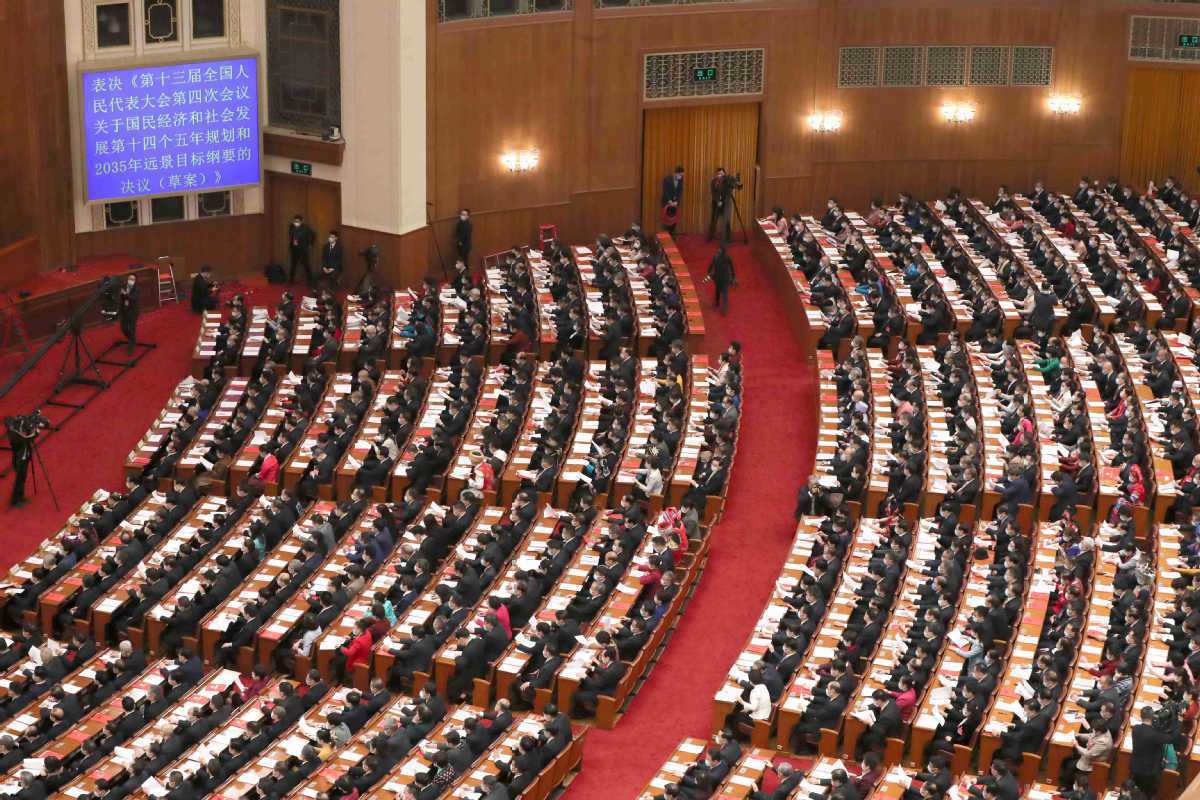
China's 2035 Vision, as highlighted in the recently concluded two sessions in Beijing, is a long-term plan that is unlikely to be found in a Western country. Of course China is well-known for its five-year plans, setting out initiatives for economic and social development. Traditionally such plans include annual GDP growth targets which are much more loose in other major economies. Yet, that five-year period is a timeline that is found in Western democracies that may vote to change political leadership every four or five years. The plans for that period in office are found in the successful party's manifesto - the basis of their being voted into office.
However, even for that five-year period in the USA for example, or five years in the UK, there is no certainty that plans will be implemented - political majorities may be slim and goals may run into opposition. Sometimes coalitions have to be made to form a government and compromises on policies follow. Later in the term, the focus has to switch to getting re-elected and modifying policies to appeal to the electorate. Gridlock in the political institutions in the Washington and battles between federal government and individual US States are a common feature.
Perhaps one of the strongest barriers to long-term planning in the West is that opposition parties need to offer an alternative vision to the incumbent party which can result in a reversal of direction, leading to “two steps forward but one backward". Some industries are privatized only to be re-nationalized, some economic activities legislated against and later deregulated. Indeed, one of the well-known Western economists, John Maynard Keynes, famously said “in the long run, we are all dead". Short-term planning rules.
It is true that groups of countries do come together to make long-term plans and an example is the Paris Agreement on climate change which President Obama signed the USA up to, only for President Trump to take the USA out and President Biden to rejoin. Long-term agreements among Western countries tend to be honored in different degrees by members. Who would have thought that the UK would no longer be a member of the EU after 48 years?
By contrast, China has made great progress toward long-term goals including eliminating poverty and creating a moderately prosperous society by political continuity under the Chinese Communist Party. Over the next fifteen years, Beijing's 2035 vision for “basic socialist modernization" sees that China's total economic size and per capita income “will climb to a new big level", with significant improvements in its economic, technological and comprehensive power, according to the communique of the fifth plenary session of the 19th CPC Central Committee.
Most notably, the goals are that per capita gross domestic product in China will reach that of a “mid-level advanced country", with a bigger middle-income group at home and “new competitive advantages" abroad. Thus, China would be a formidable economic power by 2035. Although not explicitly stated, such a vision would put China as the world's largest economy.
Recent World Bank data estimates the GDP per head of population in the USA as around $65,000 and in China as a little over $10,000. The population of China at just under 1.4 billion is over 4 times that of the USA at just under 330 million. Since the USA has 6.5 times the GDP per head of China it is clearly the larger economy. Yet as China's GDP reaches $20,000 per head, it will be the largest economy even if the USA grows somewhat. How would citizens in Western economies feel? Surely they would not begrudge the average Chinese citizen an income per head only a third of the USA and less than half that of the UK?
Yet, some Western economies are likely to see China's vision as a threat that needs to be contained. For global economic progress, the reverse is more likely to be true. China's rise to the largest economy can boost other economies and create mutual benefits for shared prosperity. Having a long-term vision is important for China because it can undertake effective long-term planning. Western economies should learn from this capability.
Colin Speakman is an economist and an international educator with CAPA: The Global Education Network.
The opinions expressed here are those of the writer and do not represent the views of China Daily and China Daily website.
If you have a specific expertise and would like to contribute to China Daily, please contact us at opinion@chinadaily.com.cn , and comment@chinadaily.com.cn





