



Sichuan-Tibet Railway 'extremely challenging' project, expert says









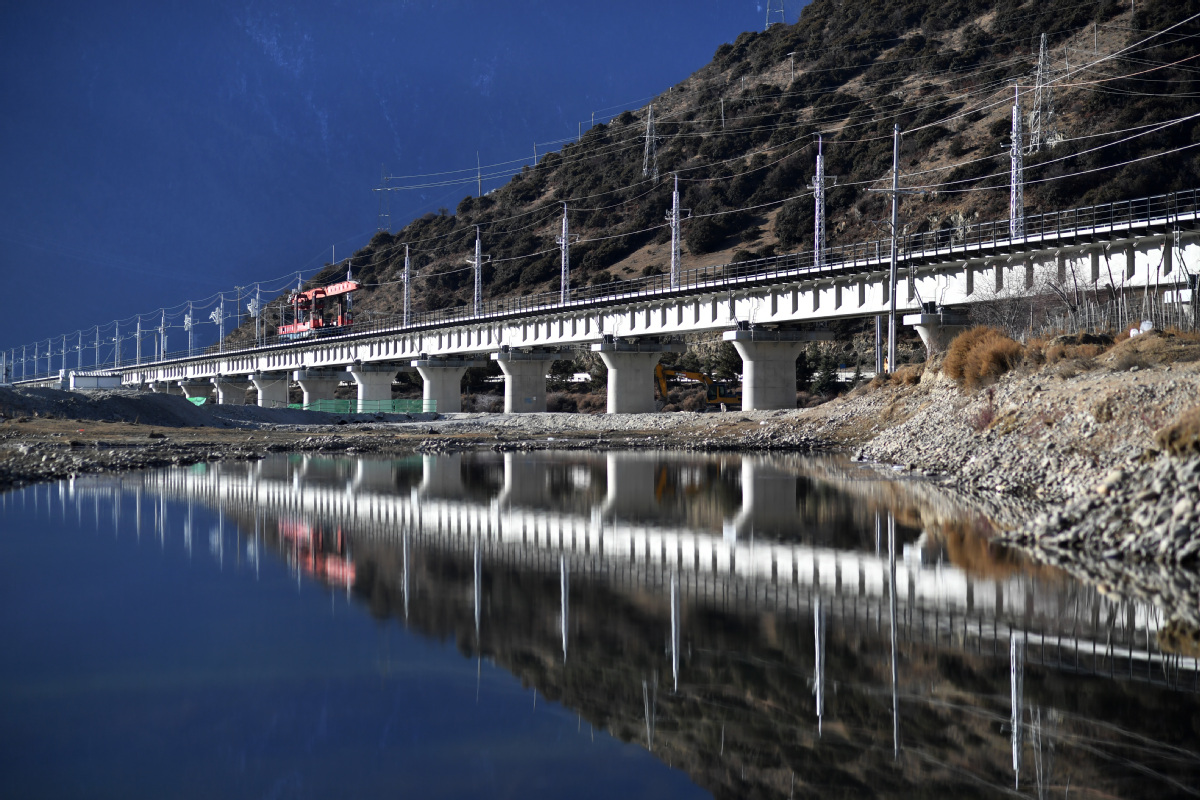
Innovations are the key to conquering difficulties in order to build the "most challenging railway project in human history "connecting Sichuan province and the Tibet autonomous region, a political adviser said during the ongoing two sessions.
"Although China has abundant experience and capabilities in constructing all types of railways, including high-speed lines and those at high altitudes and for heavy haulage, it is insufficient to rely only on previous experience to build the Sichuan-Tibet Railway because it is extremely challenging," said Lu Chunfang, an academician of the Chinese Academy of Engineering.
Lu, who is also a member of the National Committee of the Chinese People's Political Consultative Conference, made the remarks while answering China Daily's questions in a video interview during the ongoing fourth session of the 13th CPPCC National Committee.
The rail line is the second to link Tibet with the rest of the country, following the Qinghai-Tibet Railway, which opened in 2006.
Lu, the general director of the Qinghai-Tibet Railway, said the new line is much more difficult to build because of the complicated geological conditions.
More than 90 percent of the line consists of bridges or tunnels. Six tunnels are longer than 30 kilometers. The 42.5-km Yigong tunnel will become the world's longest railway tunnel once it is completed.
Thirty-one tunnels are more than 1 km below the ground, according to Lu.
He also noted that nine bridges are taller than 100 meters. The tallest bridge, which will span the Nujiang River, will be 630 meters high, which is about the same height as the Shanghai Tower, China's highest skyscraper.
Fragile ecology
The ecological conditions in the plateau areas are extremely fragile, and the project has taken careful planning and calibrated protective measures into consideration from the very beginning.
Engineers have turned to technological and managerial innovations to address challenges arising during the construction process, Lu noted.
Smart software to select the best routes to lay tracks has been developed and used in the project.
A State-level innovation center for the construction of the line will be established soon, conducting research to solve technological problems, he said.
In addition, a digital management platform, which integrates construction, safety and environmental management, has been developed.
An integrated mechanism to apply lab results to construction of the railway has also been developed.
The 1,838-km Sichuan-Tibet Railway has three sections. The Chengdu-Ya'an section in Sichuan opened in December 2018. Construction of the Lhasa-Nyingchi section in Tibet started in 2015 and is still underway. Construction of the middle section, the most difficult part of the line, between Ya'an in Sichuan and Nyingchi in Tibet, started in November.
The 1,011-km Ya'an-Nyingchi section, with a designed speed of 120 to 200 km per hour, passes through the Sichuan Basin, the Yunnan-Guizhou Plateau and the Qinghai-Tibet Plateau, climbing from 600 meters above sea level to nearly 4,500 meters.
In an instruction made at the start of construction of the Ya'an-Nyingchi section in November, President Xi Jinping said that construction of the project will face rarely seen difficulties because of geological conditions, the complex climate along the railway and the fragile environment.
Upon completion, it will boost the development of Tibet and reduce the travel time between Chengdu and Lhasa, the capital cities of Sichuan and Tibet, to about 13 hours from more than 40 now.
"Once completed, the railway's capacity will be greater than the Qinghai-Tibet Railway, and it will also be the most convenient rail corridor to Tibet. The transportation of people and cargo will greatly increase and boost local development," Lu said.
The date of the railway's planned completion has yet to be revealed.
- Toughest sections yet to be built in Sichuan-Tibet railway
- Machinery makers eye sustainable growth in 2021-25 period
- Nation rolls out blueprint for transport
- COVID-19 prevention rules for trans-provincial travel in 31 provinces, municipalities and autonomous regions during Spring Festival (As of Feb 3, 2021)


- Report blames management for deadly Yunnan tunnel flood
- Companies flock to Shanghai home appliances expo
- Three people perish in Guangdong house fire
- Experts: too early to tell if super El Nino will hit this year
- China recovers $4.95b in medical insurance funds in 2025
- China launches remote sensing satellite





