Big players win in tech deal on news sharing









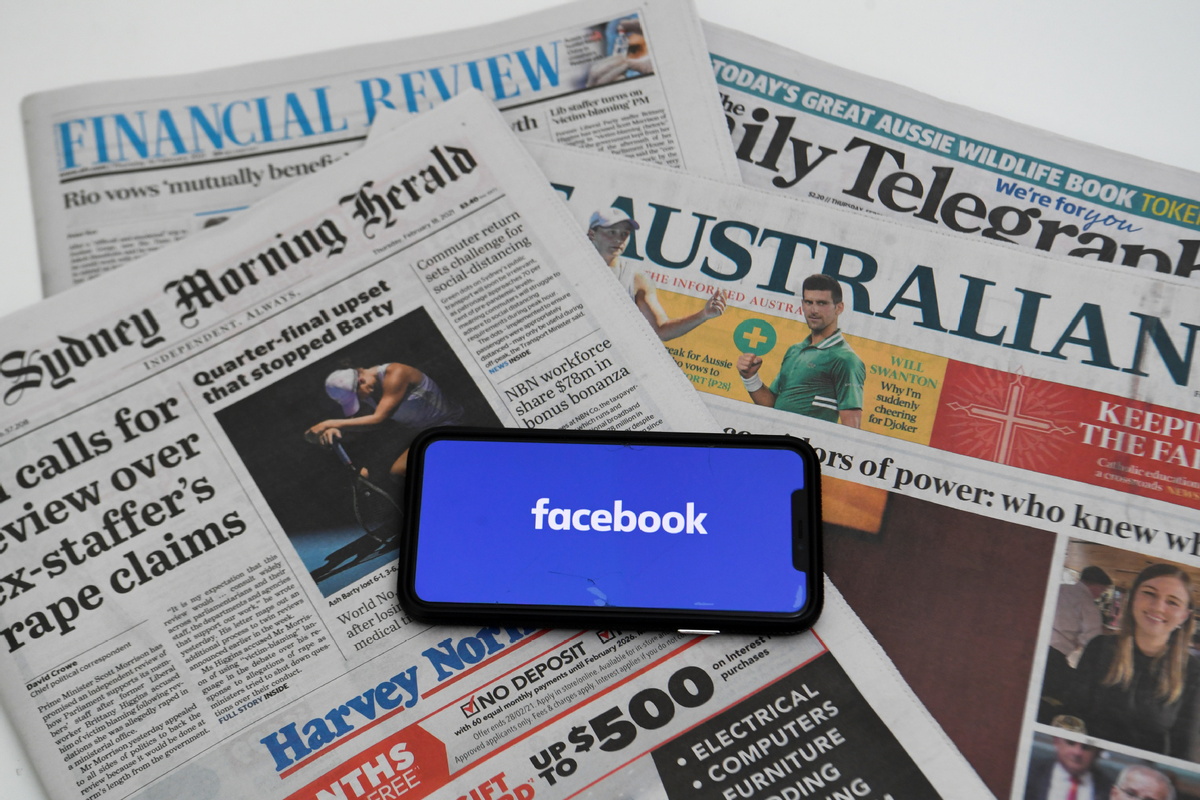
Closely watched agreement in Australia seen leaving small media outlets adrift
To some observers the Australian government's decision to amend its News Media Bargaining Code just to placate Facebook, a company based on the other side of the world, was a pathetic backdown from checking tech giants.
Yet, unlike restrictions imposed by India on Facebook and other platforms, last week's modification was seen by other analysts as a win for the government, social media, and Australia's traditional media giants.
Under the code social media giants such as Facebook and Google will have to pay Australian news publishers for displaying their content in a deal many say will benefit big media companies at the expense of the smaller, independently owned media outfits, especially in rural Australia.
Australia's media giants such as the Rupert Murdoch-owned News Corp Australia and Nine Entertainment, which owns the Fairfax newspaper group, together control most of Australia's print media.
They along with smaller media concerns in Australia, such as Seven West Media, have long claimed the likes of Google and Facebook have not only siphoned off valuable advertising revenue but in doing so lowered the quality of journalism in Australia.
The watchdog on consumer issues, the Australian Competition and Consumer Commission, held an 18-month inquiry and found there was an imbalance between the social media groups and media companies that threatened the viability of the news businesses.
While Google came to the party early, Facebook held off, only agreeing after Australian Treasurer Josh Frydenberg and Mark Zuckerberg, chairman and co-founder of Facebook, agreed to some "minor" changes to the code.
It came after Facebook flexed its muscles and banned Australian media and scores of other "non" media including COVID-19 sites from Facebook.
One amendment requires the treasurer to consider whether the digital platforms have already struck commercial agreements with news publishers before passing further regulation to make the code formally apply to them.
In the event that Frydenberg decides to enforce the code, the tech giants must be given one month's notice. The Senate passed the code on Feb 23 and by the end of last week all was back to normal.
The government got its bargaining code, Australian news businesses will get their checks, and Facebook gets a few key concessions.
What changed?
The social media behemoth negotiated small but important changes that mean there's a good chance the code may never be used at all, Tama Leaver, a professor of internet studies at Curtin University in Western Australia, told a local broadcaster.
"The code will sit in the treasurer's desk and he can pull the trigger whenever a platform is big enough to squeeze for money," Leaver said.
The losers will be smaller, independent media concerns mainly in the regions.
'Interesting experiment'
Marc Cheong, a research fellow at the Centre for AI and Digital Ethics at the University of Melbourne, said: "Politics aside, this might prove to be an interesting experiment on how social media users' news consumption changes over time, which might well prove to be a double-edged sword.
"The downside is that people who are over-reliant on using Facebook to access news might take epistemic 'shortcuts' to obtain news and information, such as sharing of non-verified anecdotes to fill the news vacuum, which increase their susceptibility to misinformation."
Tanya Notley, senior lecturer at the School of Humanities and Communication Arts at the University of Western Sydney, said this code has been on the table for years, but "it appears the final code was arrived at with the participation of too few actors and is the result of serious closed-door political lobbying".
Notley added: "It's the public who lose out here. For those who spend many hours each day on Facebook, which is a significant proportion of the Australian adult population, their information access and sharing options and choices have now been diminished."
Suranga Seneviratne, a lecturer in security from the School of Computer Science at the University of Sydney, said: "Facebook's biggest asset is its user base.… The major means of keeping user engagement is through sharing content-user generated or otherwise."