Adviser: More reforms needed to control cram schools









Editor's Note: China Daily is publishing a series of stories focusing on major issues expected to be discussed at the annual sessions of the National People's Congress and the National Committee of the Chinese People's Political Consultative Conference, known as the two sessions, the biggest annual political event in China, which generally starts in early March. Some stories will also look at how the participants in the two sessions, deputies and political advisers, perform their duties.
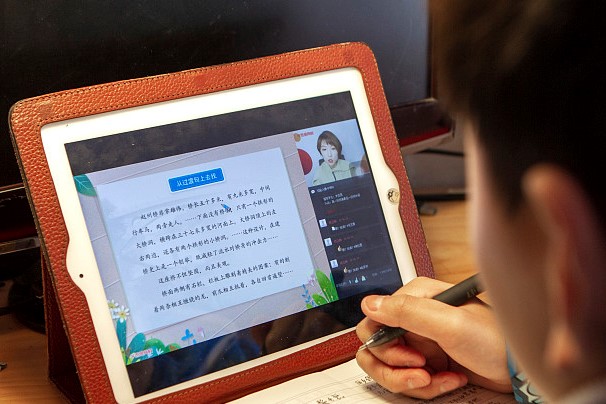
China should continue to push reforms in education and further regulate after-school training institutions to reduce the academic burden on primary and secondary school students, a policy adviser said.
Zhu Yongxin, deputy secretary-general of the 13th National Committee of the Chinese People's Political Consultative Conference, the country's top political advisory body, said that while schools have taken measures to reduce students' workloads, after-school institutions have increased the burden.
In August 2018, the General Office of the State Council attempted to ease the heavy workload of primary and secondary school students by issuing a guideline aimed at regulating cram schools.
The guideline banned cram schools from engaging in exam-oriented training and discouraged teaching students materials that are too advanced in core subjects such as Mandarin, math and English.
While education authorities have made progress in applying the regulations, there is still fierce competition for students to get into good schools.
After-school training institutions are motivated to run exam-oriented courses, leading to heavy student workloads, said Zhu, who is also vice-chairman of the Central Committee of the China Association for Promoting Democracy, one of China's eight non-Communist political parties.
"We should not pit school education and after-school training against each other," he said.
"Schools should realize that they cannot return to exam-oriented education and training institutions should not conduct advanced training outside the teaching syllabus," he said in an interview with China Daily ahead of this year's two sessions, the annual meetings of the country's top legislative and political advisory bodies.
Thousands of legislators and advisers will gather in early March in Beijing, where they are expected to discuss proposals for formulating the 14th Five-Year Plan (2021-25) for National Economic and Social Development and the Long-Range Objectives Through the Year 2035.
The excessive academic burden on students is why the proposals have stressed the need to regulate after-school training institutions, Zhu said.
While schools should play the main role in children's education, after-school training institutions can supplement this with personalized and diverse training, he said.
Education authorities should guide training institutions to make good use of their strength in course research and development, he said. Training institutions that are substandard or not properly accredited should be closed, while quality ones should have more room for development, he added.
As a leading education expert, Zhu said his proposals for this year's two sessions mainly focus on that area and the culture sector.
"I am concerned about the gender imbalance in kindergarten, primary and secondary school teaching. There has been a low proportion of male teachers in these schools as teaching is not regarded as a profession with a high social status," he said.
Zhu is also focused on promoting universal reading, which he said he believes is key to addressing the imbalance in the quality of education between urban and rural areas.
"We should promote education equity by enabling all students, urban or rural, to have more opportunities in reading. Every student, especially those from less developed areas, should have access to all kinds of books. Equity in reading will promote equity in education."
He suggested that more needs to be done to promote reading among government officials and teachers to encourage more people to be interested in the pursuit.
Education opening-up
Regarding international cooperation in education, he said China will not slow its opening-up in the field and will enter a high-level and quality-oriented phase. That will enable more contributions to educational development worldwide during the 14th Five-Year Plan period.
The country will continue to promote the quality and efficacy of international education cooperation in its pursuit of high-quality development, Zhu said.
"We are committed to building a community with a shared future for mankind and we firmly believe that China and the rest of the world are highly dependent on each other," he said.




- China's Global Governance Initiative receives positive feedback at forum
- China's Xizang sees steady tourism growth in 2025
- First-of-its-kind pearl auction held utilizing Hainan FTP
- Agarwood exhibition steeps Shanghai museum in fragrance
- The Fujian Coast Guard conducts regular law enforcement patrol in the waters near Jinmen
- IP protection for new fields to improve