The forgotten great wonder of Hangzhou









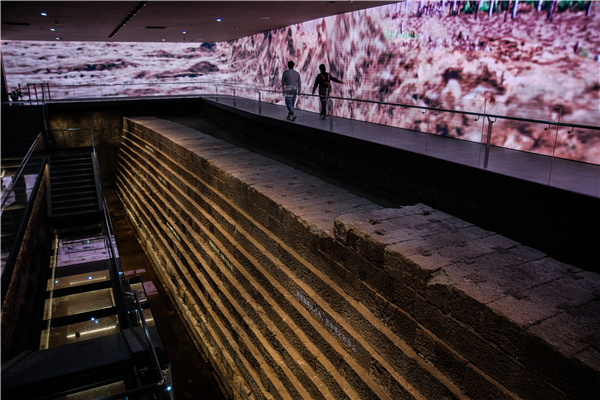
It cost about nine households' annual family spending at the time to build just one meter of such a seawall, and in Qianlong's reign nearly 47 kilometers of yulin-style seawall were built, Yao says.
Because of the cost, the project took years to complete, but over the decades people managed to turn the seawall in Haining that had to keep back the most turbulent tides into the sturdiest of yulin-style seawalls.
Over the 60 years of Qianlong's reign he spent 3.8 million liang of silver on the project. A liang was an ingot forged from gold or silver and used as a form of currency, a single unit of which in this instance equates to about 300 yuan ($45) today, meaning the emperor poured more than 1 billion yuan into it.
Nevertheless, Yao says it is an exaggeration, as popular lore has it, that Emperor Qianlong spent one-third of the empire's income on building the seawall, but the extent of the spending reflects the great importance people of the time attached to the project.
Another popular tale has it that during the late Eastern Han Dynasty (25-220) a local officer, Hua Xin, led citizens to build the earliest seawall using just dirt or firewood to resist the tide's impact on agriculture.
Today's celebrated West Lake was just a seasonal lagoon surrounded by a sandbank at the time, and how they looked at any time depended on the level of sea tide; the urban area was just a shallow bay.
The construction of the seawall severed the lagoon from the river and the sea.
The lagoon then gradually turned into the freshwater lake we know today, and the sediment brought by river current continuously changed the riverway and the land shape, according to the city planning exhibition hall of Hangzhou.
During the Five Dynasties and Ten Kingdoms, the king of the Wuyue Kingdom, Qian Liu (852-932), promoted the first major technical innovation in building the seawall as laborers put stones into long bamboo cages that were piled together to impede the tide.
In later centuries Zhejiangers developed efficient, advanced construction skills, improved management and investment, and worked to prevent corruption.
For example, during the Ming Dynasty (1368-1644) an officer named Huang Guangsheng (1506-86), the inventor of the yulin-style seawall, created a labeling system to facilitate maintenance of the project.
The seawall was divided into 140 sections, each about 70 meter long and marked with a Chinese character in an order according to the One Thousand Character Primer, a widely taught primer for children going back more than 1,400 years.
The system made it easier to recognize those who built a certain section. They would be responsible for repairing their own part of the wall and face penalties for any shortcomings.
The Qing Dynasty also set up an annual maintenance regime under which the construction workers would be responsible to maintain their work for 10 years.
During the process, local officers of Zhejiang, a province with a rich business ethos, used spare money for lending, and soon the province was able to cover the expense without fiscal support from Beijing.
And according to Lang the provincial-level administration's taking care of river harnessing, seawall building and flood defense of the Qiantang River stems from the administrative system of the early 20th century, and efforts to reinforce the seawall have continued to this day.
The provincial water resources department launched a project last year to strengthen the seawall of about 2,000 kilometers that extends along the province's estuaries and sea shore by 2030.
The project, aiming to improve the seawall's capability of resisting typhoon and storm surges, is to optimize a project completed at the end of the 20th century that has proven to be invaluable, but that was limited by financial constraints of the time.
Chinanews.com said in November that over the previous 20 years the number of people who benefit from the seawall's protection in the province had nearly doubled and GDP had risen about 15-fold.
The seawall around the Hangzhou Bay area alone has been protecting a population of more than 16 million.
The original construction standard has lagged behind economic and social development, Chinanews.com said, adding that the new project will also integrate ecological, cultural, landscape and recreational considerations.
Construction of 150 kilometers in the cities of Jiaxing and Taizhou was due to begin within the year, the provincial government said in July.