



State enterprises power ASEAN projects









RCEP, BRI herald massive growth opportunities for centrally administered firms
China's State-owned enterprises will explore more business opportunities in a range of areas in the markets of the Association of Southeast Asian Nations, following the recent signing of the Regional Comprehensive Economic Partnership agreement, said business leaders.
As China and ASEAN look forward to the pact's early implementation, many opportunities will likely arise from the tangible development and regional economic integration brought about by the Belt and Road Initiative.
The two sides have complementary industrial structures with their bilateral trade value growing in both goods and services, business leaders said.
Thanks to the high-level free trade agreement between China and ASEAN, as well as two-way production capacity cooperation, their enhanced industrial and value chains have helped companies on both sides to better cope with uncertainties caused by protectionism, the COVID-19 pandemic and the global recession, said Xu Ningning, executive president of the China-ASEAN Business Council.
In addition to fast growth of big-ticket industrial parks and infrastructure projects such as the China-Singapore Suzhou Industrial Park and the China-Laos Railroad, the two sides should enrich regional industrial chains in key sectors like infrastructure, manufacturing, agriculture and healthcare over the next decade, Xu said.
Despite slowing global trade, economic recession and serious travel disruptions, China's direct investment in ASEAN markets surged 76.6 percent on a yearly basis to $10.72 billion in the first three quarters of this year. The top three investment destination countries were Singapore, Indonesia and Laos, said the Ministry of Commerce.
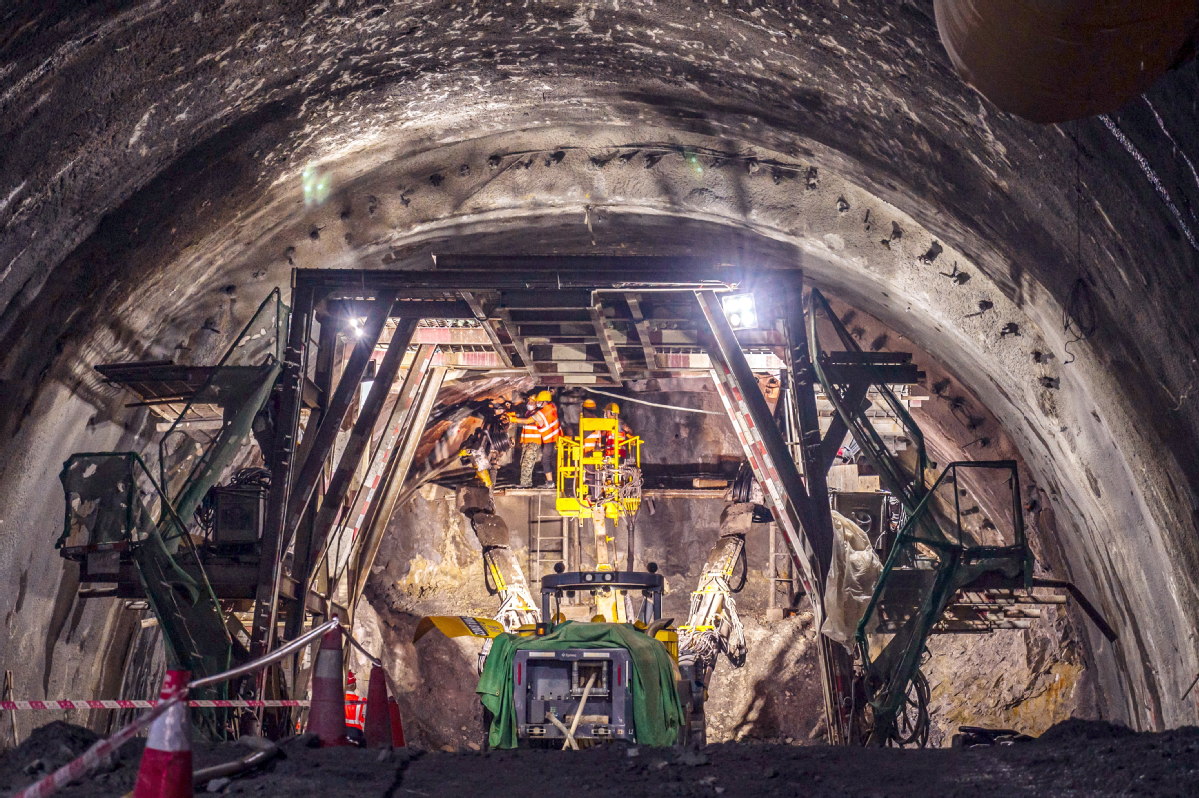
CCCC Tianhe Mechanical Equipment Manufacturing Co plans to export more tunnel boring machines, or TBMs, and provide related services to the ASEAN market over the next 10 years, as it believes that demand for such products will surge as many countries are seeking to create jobs and stimulate trade flows via mega infrastructure and transportation projects, which require tunnels.
The No 1 tunnel on the Jakarta-Bandung high-speed railway line in Indonesia was completed in late November using the company's TBM. The railroad is the first with a maximum speed of 350 kilometers per hour in Southeast Asia. It is also an icon of the BRI and Indonesia's Global Maritime Fulcrum strategy, the country's grand maritime vision.
Zhang Boyang, chairman of the Jiangsu province-based company, said the 1,469-meter tunnel is being built through a mixture of cohesive soil, gravel, sandy soil and fine gravel that has a high underground water level and abundant surface water. It has to pass through a volcanic accumulation layer, with poor self-stabilization capacity.
The 2,600-metric-ton TBM with a 13.19-meter diameter and 101-meter-long cutter was designed and developed by CCCC Tianhe, a subsidiary of Beijing-based China Communications Construction Co Ltd, in response to the complicated geological conditions.
With such internationally leading technologies as subsidence control, stratified backwash, a cutter with long duration and real-time tool wear monitoring were used in the machine.
Once it is operational, the 142-kilometer railway will shorten travel time between Jakarta and Bandung to 40 minutes. It will promote construction of the Trans-Asian railway network and effectively relieve traffic congestion between the two cities. It is expected to play a role in forming the Jakarta-Bandung economic corridor and boost Indonesia's economic growth, Zhang said.
Wang Bin, vice-president of Power Construction Corp of China, or PowerChina, said the signing of the RCEP agreement is an encouraging move to highlight multilateral cooperation, openness, free trade and investment. It will impart fresh impetus to China-ASEAN economic and trade ties for years to come.
The company reported that its third unit of the fourth cascade in phase II of the Nam Ou River Cascade Hydropower Project in Laos was connected to the national grid in October, a new landmark development for the giant hydroelectric power project.
The project is being developed in two phases. The 550-megawatt first phase entered operation in April 2016, after which construction on the four units of the 732-MW second phase began.
Wang said the project's cumulative power generation to date has exceeded 6 billion kilowatt-hours.
The Nam Ou River Cascade Hydropower Project is the first hydropower development being undertaken by a Chinese company involving overall river basin planning and a build-operate-transfer, or BOT, investment model.
When completed, it will contribute to more than 12 percent of Laos' electricity supply. It will also power the country's industrial upgrading, major infrastructure construction and urbanization, while helping to alleviate poverty, he said, adding that the whole project is scheduled to be completed by the end of this year.
On Nov 27, at the 17th China-ASEAN Expo in Nanning, the Guangxi Zhuang autonomous region, Chinese and ASEAN companies signed agreements for 86 investment cooperation projects at home and abroad. The projects involve total investment of 263.87 billion yuan ($40.13 billion).
Many of these deals were sealed by China's centrally administered SOEs, including China Resources (Holdings) Co Ltd, State Power Investment Corp and China Energy Engineering Group Co Ltd, along with their partners in ASEAN, said the Ministry of Commerce.
"Chinese companies, especially SOEs, have been helping develop infrastructure and improve connectivity within ASEAN economies. A large number of industrial parks between them have also contributed to trade and investment cooperation activities," said Zhang Jianping, director-general of the Beijing-based China Center for Regional Economic Cooperation.
As China and the ASEAN will continue to deepen cooperation under the guidance of the Strategic Partnership Vision 2030, Zhang said the recently signed RCEP, which aims to cut tariffs, further open markets and lower trade and investment barriers, will boost economic development and further integrate the regional market over the next decade.




















