



Barriers to use of renminbi removed









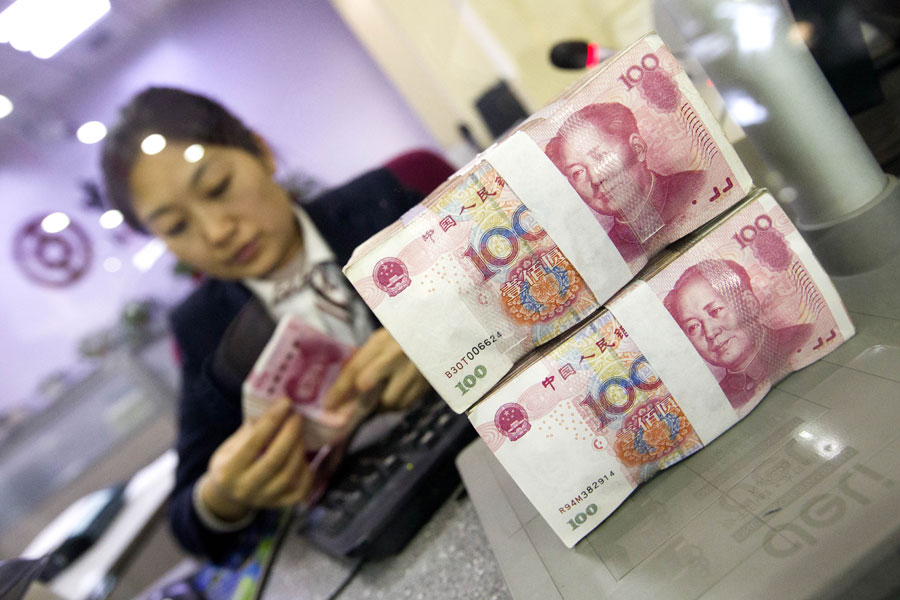
Chinese monetary authorities will further remove barriers to use the renminbi in domestic and overseas markets, and strengthen the macro-prudential management of cross-border capital flows, a senior central bank official said on Sunday.
To further promote the financial structural reform under its new development strategy of "dual circulation", China needs to promote the flexibility of the renminbi exchange rate and improve the convertibility of the capital account, said Zhang Xuechun, deputy director general of the Research Bureau of the People's Bank of China, the central bank.
China aims to create a level playing field for the renminbi and other major convertible currencies, and reduce obstacles to the free use of the renminbi in onshore and offshore markets, she said at a seminar held by the Chinese Academy of Macroeconomic Research, a think tank under the National Development and Reform Commission, the national economic planner.
"We are improving our financial market regulations in order to integrate into the global financial market."
Financial regulators will also strengthen the macro-prudential management-which protects against risks-of cross-border capital flows through monitoring, early warning and countercyclical adjustments, Zhang added.
Other financial reforms to develop the country's new economic strategy include establishing a multilayered capital market, promoting green finance and upgrading financial inclusion to support smaller businesses and vulnerable groups, she said.
Experts at the seminar on Sunday said that financial reform is one of the key areas in China's 14th Five-Year Plan (2021-25). Besides, fiscal, energy and trade policy reforms will support the change of China's growth pattern, which puts the emphasis on the domestic market.
Gao Peiyong, vice-president of the Chinese Academy of Social Sciences, said at the seminar that the fiscal reforms, especially for the tax and fee cuts, should focus on securing the market entities and reducing the tax burden of smaller businesses over the long term, to stabilize employment.
Wang Zhongying, head of the NDRC's Energy Research Institute, said China will take stronger and more efficient measures to achieve its goals of reaching its CO2 emissions peak before 2030 and achieving carbon neutrality before 2060, which was announced by President Xi Jinping on Tuesday at the high-level meeting in honor of the 75th Anniversary of the United Nations.
"In order to achieve this goal, it is necessary to build a modern energy system to solve the problem of the high-carbon structure in the energy system," said Wang.
Among all these reform measures, Chinese officials and experts recently discussed at length the opening of the capital and financial accounts.
Capital account opening is on the schedule of the country's overall economic reforms. Monetary authorities and financial regulators are designing the key measures to promote capital account opening in the next five years, Lu Lei, deputy head of the State Administration of Foreign Exchange, said at the Global Asset Management Forum in Shanghai on Saturday.
China's capital account opening, according to the global standards set by the Organization for Economic Cooperation and Development, had been about two-thirds accomplished by June, Lu added.
Priority set
Recently, Chinese financial policymakers reached consensus that the opening of the financial market to foreign institutions should take precedence over the reform of the foreign exchange rate regime, said analysts.
A resilient and international financial market to provide financial products and services to global investors, can form massive trade volumes, which is the determining mechanism of a free-floating foreign exchange rate, they said.
Along with financial opening-up, the flexibility of the renminbi exchange rate is expected to be enhanced during the opening-up process, said Zhang of the PBOC.
"Regardless of whether the renminbi exchange rate will be free floating in the future, the market-oriented reform of the exchange rate regime has been fixed as one of China's economic development goals. After the renminbi exchange rate broke through the psychological barrier-seven per US dollar-last year, the volatility of the exchange rate has increased, and a more flexible renminbi will be seen in the future," said Guan Tao, chief economist at BOC International.
Since July 2019, financial opening-up has accelerated as financial regulators lowered the market access restrictions for foreign financial institutions' wealth management subsidiaries, pension fund management companies, money brokerage companies and rating agencies.


















