



Breakthroughs in tech lift soybean production









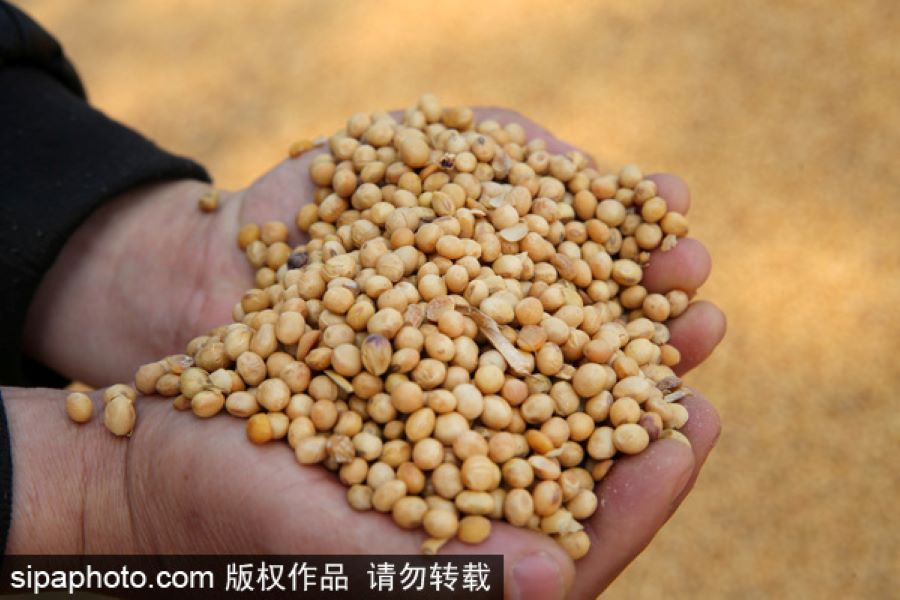
Nation has reached 'world-class level' in some research areas, scientist reports
Technological breakthroughs have resulted in an increased output of soybeans in China in recent years, and further progress is expected to improve domestic supply, said a top expert.
"National support for agricultural scientific and technological research that covers the whole chain of agricultural production has played a crucial role in ensuring food security, which has withstood tests such as the COVID-19 pandemic," said Han Tianfu, chief scientist for soybeans under the Ministry of Agriculture and Rural Affairs.
"In terms of scientific research on soybeans, China has continued to make progress in recent years and has reached world-class level in some research fields."
Last year, Chinese scientists published over 700 soybean research papers in English in various influential international science journals, more than any other country in the world, said Han, also a researcher at the Chinese Academy of Agricultural Sciences.
With the adoption of new technologies, per-hectare production of soybeans in China reached more than 1.9 metric tons last year, an increase of 83 percent since 1978, he said. A number of scientific and technological achievements have been made in soybeans in recent years, contributing to increased yields.
In recent years, about 200 new soybean cultivars have been released annually, extending soybean production to most parts of China, Han said. Zhonghuang-13, a superior cultivar bred by scientists from the Chinese Academy of Agricultural Sciences, had been grown in over 7 million hectares of farmland across China by the end of 2018, which helped increase yields by 16 percent in Anhui province.
In Xinxiang, Henan province, soybean yields exceeded 4.6 tons per hectare in a pilot farmland last year, 2.5 times the national average level, due to promotion of new farming technologies that involved innovative no-tillage and stalk-covering methods, Han said.
The latest genome-editing technologies have also been used to develop new soybean cultivars that can adapt to low-latitude areas in southern China.
The research, which used a genome-editing tool known as CRISPR/Cas9 to "knock out" two key genes that regulate soybean flowering time and maturity, made it possible to promote soybeans in tropical regions, Han said.
Existing major programs funded by the government, such as China Agricultural Research System, which incorporates agricultural researchers across China in various disciplines and covers 50 industries, have played an important role in the elevation of agricultural research and development, he said, adding more progress is expected in the next few years.
Although the soybean is native to China, the country has relied on imports, mostly from Brazil and the United States, to meet increasing domestic demand for edible oil and animal protein. Most of the 88.5 million tons of soybean it imported last year-accounting for more than 80 percent of domestic consumption-was processed into oil and animal feed.
"Compared with major crops such as rice, wheat and corn, soybean has much lower yields and requires more land, which is a major reason why it has not been promoted as extensively in China because of limited arable land," Han said.
However, efforts on improving production of soybean in China have never stopped, Han said.
Last year, total soybean production in China exceeded 18 million tons-a historic high and an increase of 13 percent compared with the previous year, according to the National Bureau of Statistics.
"To rejuvenate soybean production, more investment is needed in the next few years in soybean scientific research and improving the application of the latest technological achievements, such as new soybean strains created by biotechnology," Han said.
Meanwhile, with big gaps expected to remain between domestic supply and demand, changing unhealthy eating habits that rely on too much oil and animal protein can also reduce demand for soybeans, he said. Thus, domestic supply could meet demand and China would rely less on imports.





- China's Global Governance Initiative receives positive feedback at forum
- China's Xizang sees steady tourism growth in 2025
- First-of-its-kind pearl auction held utilizing Hainan FTP
- Agarwood exhibition steeps Shanghai museum in fragrance
- The Fujian Coast Guard conducts regular law enforcement patrol in the waters near Jinmen
- IP protection for new fields to improve














