



AI key to medical innovation









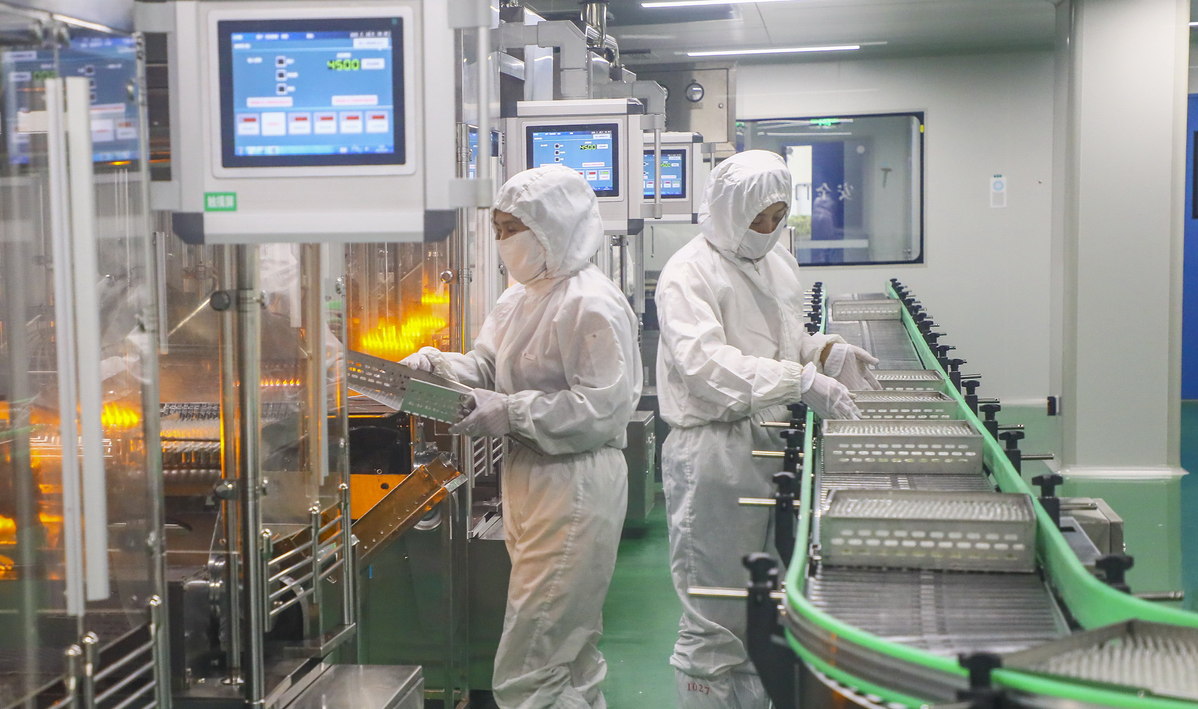
Cutting-edge developments help cut corporate expenses, boost efficiency
Apart from facial recognition, telecommunication and Chinese chess matches, artificial intelligence is now being applied in pharmaceutical research and development to help scientists develop innovative drugs.
Hyper-dimension, a Beijing-based high-tech pharmaceutical company, is now using AI to find a possible cure for COVID-19.
It is currently working with the Institute of Materia Medica under the Chinese Academy of Medical Sciences to take advantage of AI to find a treatment for COVID-19 among existing drugs. The company said the project is running smoothly and a drug is expected to come into the market soon.
"Using AI, we run the testing model and see what kind of drug matches the protein of the novel coronavirus. Once the drug is fixed, we conduct bioassay to test the efficacy of the drug," said Qin Bingjie, chief executive officer of Hyper-dimension.
The company is also teaming up with another institute which has been working on the coronavirus for over 10 years to develop a new small molecule specific drug for COVID-19. The first phase of the cooperation is in process.
"As the novel coronavirus mutates very quickly, merely relying on vaccines is not enough. The fundamental solution is a specific drug," Qin said.
Traditional methods to develop innovative drugs are explored through the accumulated experiences of scientists through which they design the drugs and try them out one by one, according to Qin.
Generally, it takes 12 years and a large sum of money to develop an innovative drug. When AI is introduced into R&D through deep learning, machines take the place of scientists to design the drugs. As a result, the time to develop an innovative drug is reduced by two to three years and the cost is cut by half.
"Through traditional methods, it takes three years on average to lock onto a candidate compound. With the help of AI, it only needs one year," he said.
"The application of AI in drug R&D is an inevitable trend. Because of the high efficiency and accuracy of AI prediction, and its powerful data processing and computing capabilities, more and more people depend on AI technologies to develop innovative drugs," said a report from Beijing-based think tank EqualOcean.
"AI-based virtual testing and drug screening save corporate costs. The AI model using the physiological and pharmacological information in the big database can simulate and predict the experimental and clinical performance of the newly developed drug according to its own chemical characteristics, thereby greatly saving R&D costs," the report said.
Qin said that AI makes predictions such as the possible side effects before clinical tests, and helps avoid possible pitfalls in advance. If possible problems may occur, AI helps to modify the molecular structure of the drug. Therefore, the success rate of clinical trial is greatly increased.
Wai Keong Tang, director of the think tank committee of Macao Youth Association of Patriotic Education, said: "AI shortens the time of finding the target drug, as AI algorithms allow developers to quickly spot the best drug candidate for a target or molecular compounds of subsequent drug candidates, including protein sequence, molecular structure, and small molecule composition among others."
He said AI improves the success rate of finding innovative drugs. It makes it convenient to compare new drugs with old drugs to reduce the probability of failure in clinical trials and increases the success rate of each stage of drug development.
"In addition, AI lowers the costs and time to develop new drugs and new treatment solutions," he added.
Qin said that with the advancement of the industry, AI will be further applied to the R&D of innovative drugs. In addition, China has the environment to encourage pharmaceutical innovation, where generic drugs have limited development room, and enterprises are encouraged to develop innovative drugs.
"The future is promising," he said.
In the future, Tang said, a sharing platform can be established so researchers, enterprises and individuals can share and search for scientific literature and target data. They can then do a good job of processing and storing data sets, which is conducive in increasing the efficiency of researchers to use machine learning algorithms to identify data.
"Besides, favorable policies should be offered to enterprises for the development of new drugs and treatment plans for rare diseases and diseases with high treatment costs, helping them to overcome difficulties," he said.




















