Leaps and bounds in charging tech expected as corporations compete









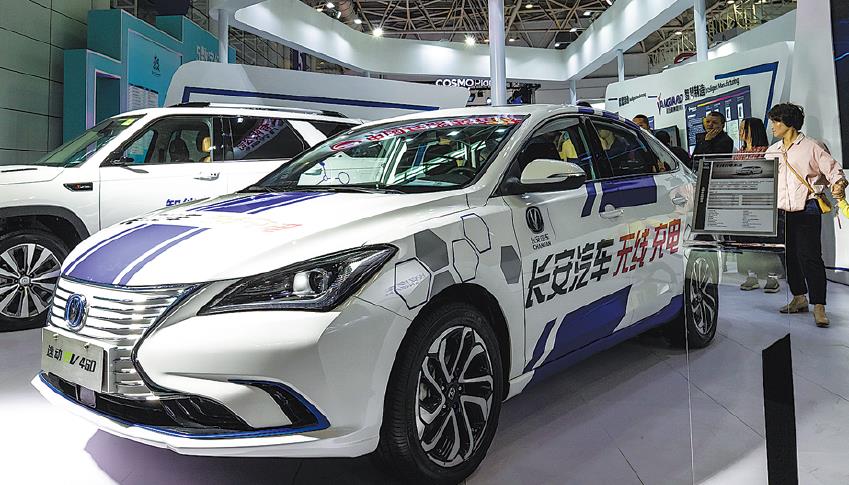
Starting gun fired for enterprises to launch products that power car batteries wirelessly
Wireless charging technology, which aims to relieve electric car drivers' range anxiety, is predicted to race into commercialization and competition, as a raft of domestic and overseas players make strides in the field.
"We have reached cooperation agreements with more than 30 automakers in China. And our self-developed wireless charging technology will soon be used in mass-produced electric vehicles," said Wang Zhe, chairman of Beijing-based wireless charging products and solutions provider Invispower, China Automotive News reported.
In the domestic market, a number of enterprises have taken the lead and the commercialization and competition of wireless charging for electric vehicles signals the start of the race, Wang added.
Great expectations of safety, convenience and economy have been placed on wireless charging technology for electric vehicles.
As the charging transmitter of wireless charging technology would be buried under the ground, charging would not be affected by bad weather and leakage would be avoided.
In theory, as long as there is a parking space, facilities can be built for wireless charging, which is expected to help cut users' waiting time.
Up to now, a raft of industry participants are working on the research and development and production capacity of wireless charging-related products.
Some domestic players have developed products to solve targeted problems.
Aiming to solve the low power and low efficiency of wireless charging products, ZXNE, a subsidiary of Chinese telecom equipment-maker ZTE, upgraded its wireless charging technology.
This helped its products increase their charging efficiency from below 90 percent to around 93 percent.
Another wireless charging product supplier, ZoneCharge, has developed multi-power wireless charging products.
They span 500 watts, 3.7 kilowatts, 7.7 kW, 11 kW and 30 kW, according to the company Chairman Xu Baohua. He said: "This is the basis for going commercial."
At the same time, a group of domestic universities and scientific research institutions have made breakthroughs in technologies relevant to electric vehicle wireless charging. They include Harbin Institute of Technology, Southeast University, the Chinese Academy of Sciences and South China University of Technology.
Zhang Bo, a professor at the school of electric power engineering in South China University of Technology, told China Automotive News that the "catch-up" of wireless charging technologies for electric vehicles in China has become increasingly "evident".
Nevertheless, the wireless charging technology for electric vehicles in China is still in the stage of research and development and engineering demonstration. Commercial applications at scale are still some way off, according to Wang Lifang, a researcher with the Institute of Electrical Engineering of China Academy of Sciences.
Some companies in the United States have taken the lead in not only improving the technical strength, but also prompting commercial applications, insiders said.
Drive 11 is a wireless charging system for electric vehicles developed by American technology company WiTricity.
In 2018, it reached a cooperation deal with German auto giant BMW to equip the 530e iPerformance sedan with the system.
China, as the world's largest market of electric cars, is also a key market for WiTricity.
The company is in partnership with some Chinese companies in terms of wireless charging technology, according to a senior executive.
Evatran, another American company, developed a wireless charging system with two alternatives of power, 3.6 kW and 7.2 kW, which has provided wireless charging technology support for models including the Tesla Model S sedan and BMW i3 compact.
In May, the Standardization Administration of the People's Republic of China released four standards for electric vehicle wireless charging. It proposed specific requirements and testing methods for the performance, safety and function of wireless charging systems.
The standards are of great significance to aid the development of China's electric vehicle wireless charging industry and help enrich their application scenarios, according to insiders.
In the long run, wireless charging technology is expected to be a "standard configuration" of autonomous electric vehicles.
"Maybe, next year, each level-3 autonomous-driving electric car may be equipped with a wireless charging system," the Invispower Chairman Wang said.