Why Hainan free port is not a threat to HK









The Chinese government's plan to transform the island province of Hainan into a free trade port and largest special economic zone (SEZ) in the country can be traced to the early days of reform and opening-up. Following the establishment of the first SEZs in Guangdong province and opening up of 14 coastal cities to overseas investment, the government unveiled its plan to transform Hainan into the country's largest SEZ in 1988.
Yet the West sees the Chinese government's long-term plan for Hainan as a response to the violent demonstrations in Hong Kong since the middle of last year and the controversial trade war Washington has launched against Beijing.
In reality, the threats to the Hong Kong Special Administrative Region lie elsewhere.
Vital link in 21st Century Maritime Silk Road
Things began to change in Hainan in 2009, when the central government decided to turn the province into an international tourist destination by the early 2020s. With growing investment in the province, particularly in the real estate sector, Hainan came to be seen as an alternative to tourist destinations in Southeast Asia by the early 2010s and a vital node in the 21st Century Maritime Silk Road, as part of the Belt and Road Initiative.
And due to rising protectionism in some Western economies, Hainan's position has become more important in China's foreign trade. In early 2020, China's trade with ASEAN member states accounted for 15 percent of its total trade volume, compared with 11 percent with the United States and 14 percent with the European Union.
Thanks to its proximity to Southeast Asia, Hainan has unique advantages as a future free trade port. With a population of more than 9 million, Hainan has about 2 million people more than Hong Kong (and almost twice more than Singapore), and by land area-35,000 square kilometers-it is more than 30 times the size of Hong Kong (and nearly 50 times larger than Singapore). That's vital for an international trade hub.
Port and trade hub with global influence
According to the four-stage development timeline, Hainan should become an operational free trade zone by the end of this year. And by 2025, Hainan's free trade port should be in place, complete with a modern, friendly business environment, improved industrial competitiveness, and sound rule of law. Between 2025 and 2035, the free trade port's operations are expected to mature. And by 2050, Hainan should become internationally influential.
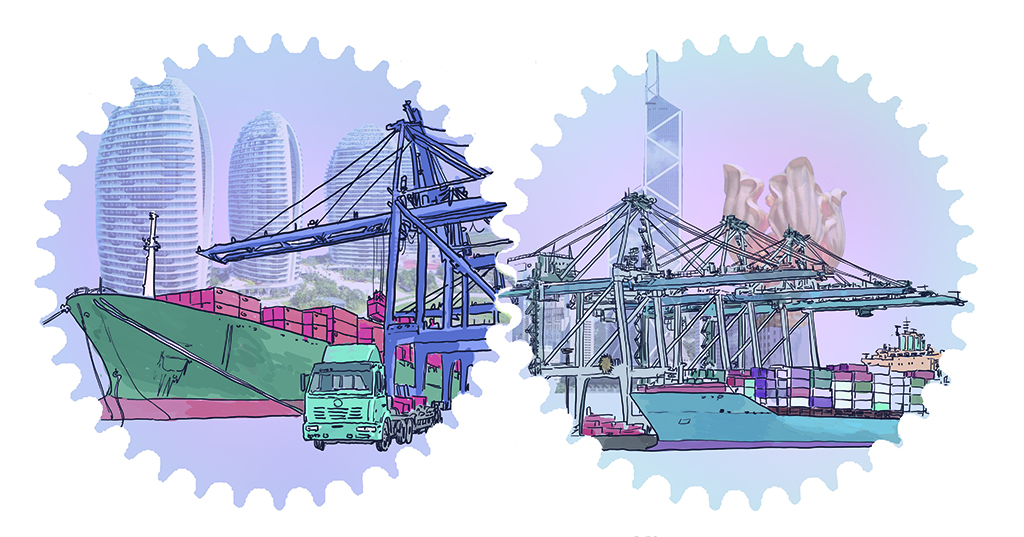
The Hainan masterplan seeks to liberalize cross-border flows of trade, investment and capital, as well as people and data. Yet its positioning and industrial focus are different from that of Hong Kong. As such, Hainan will play more of a complementary role-instead of becoming a competitive rival-to Hong Kong.
Under the 1992 US-Hong Kong Special Policy Act, and after Hong Kong returned to China in 1997, Washington has treated Hong Kong separately from the Chinese mainland in matters of trade, exports and economic control.
Over the past two decades, there have been attempts by mainly localist and separatist groups in the special administrative region to undermine the status quo. These attempts intensified in the middle of 2019, leading to violent demonstrations that undermined Hong Kong's economy, pushed it into recession even before the novel coronavirus epidemic broke out.
At the same time, the nexus between some Hong Kong radicals and US politicians prompted Washington to pass the "Hong Kong Human Rights and Democracy Act", which allows the US administration to impose sanctions on mainland and SAR officials and requires US agencies to conduct an annual review to determine whether changes in US-Hong Kong trade relations are warranted.
In China's view, that amounts to a blatant interference in China's internal affairs. Such a law would be comparable to a Chinese law allowing Beijing to impose sanctions on US politicians, and federal, state and municipal officials.
In late May, US Secretary of State Mike Pompeo told the US Congress that the Hong Kong SAR no longer enjoys a high degree of autonomy. A few days later, the US president announced some sanctions against the SAR. These moves are paving the way to bad business, and are another major policy blunder.
There are some 85,000 US nationals in Hong Kong. The city also hosts 1,300 US companies with their Asian headquarters. If the new act is implemented, many of these US companies could shift to Singapore or other countries, which would penalize their cost structure, or relocate to other parts of China and thus defeat the White House's objectives. In both cases, though, the US would lose its goods and service trade surplus of $34 billion with Hong Kong, which would cost still more domestic jobs in the US.
The long-term diplomatic impact could be worse. For decades, US presence in Hong Kong has been a major influence channel in East Asia, while US companies' regional headquarters in Hong Kong and their subsidiaries in China have served as vital instruments of enhancing mutual understanding. The White House seems intent to undermine both.
US act on Hong Kong could derail its growth
More importantly, since the US Hong Kong act could derail Hong Kong's economic and social development-contrary to what the White House claimsit represents everything but the best interests of the city. No wonder some leading Hong Kong protesters have, belatedly, warned about its consequences.
Washington's policy mistake could also trigger a process in which Shanghai, given its free trade zone and the Lingang New Area, could receive many of the US companies, particularly financial giants, that would be forced to leave Hong Kong.
And thanks to the development potential of the Guangdong-Hong Kong-Macao Greater Bay Area, technology giants shifting from Hong Kong could flock to Shenzhen and elsewhere, while those that operate in Southeast Asia or have significant shipping interests could move to Hainan.
Hong Kong's greatest threat is neither the myth that Beijing wants to turn it into "just another Chinese city" nor Hainan's development as a free trade port. Instead, Hong Kong's greatest risk is irrelevance, which misguided US policies would accelerate. If the White House prevents Hong Kong from capitalizing on its unique advantages-world-class financial services, shipping and trade-the city would face accelerated decay.
The author is a strategist of the multipolar world and founder of Difference Group. He has served at the India, China and America Institute (USA), Shanghai Institutes for International Studies (China) and the EU Centre (Singapore). The views don't necessarily represent those of China Daily.