US-China economic decoupling seen as 'unlikely'









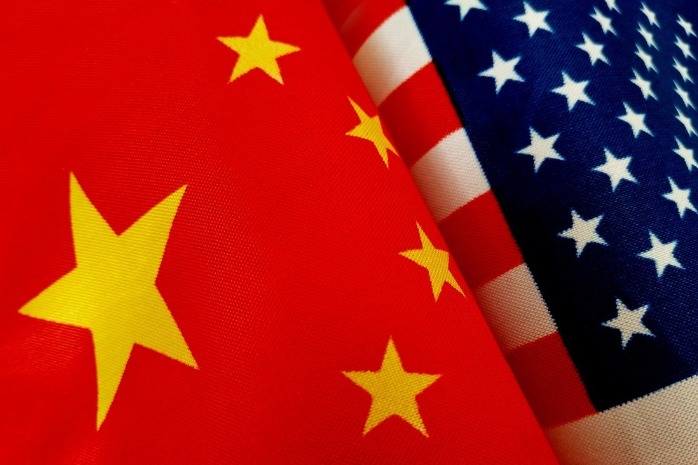
A full-scale decoupling of the world's top two economies is "really unlikely", and an escalation of tensions between China and the United States would have global knock-on effects during and after the current pandemic, several experts at a Washington think tank said Thursday.
According to a survey released by the American Chamber of Commerce in the People's Republic of China (AmCham China), the American Chamber of Commerce in Shanghai (AmCham Shanghai) and PwC Chinalast month, 44 percent of executives of US firms doing business in China said US-China economic decoupling is impossible; 36 percent reported no change in their view compared with last year; while 20 percent said decoupling will be accelerated by COVID-19.
In light of the outbreak, such talk of decoupling has gained increased relevance as some US politicians call to bring manufacturing, medical goods in particular, back to the US.
"I do not think, though, that in the short term we are going to see what people are calling a full-scale decoupling of the two economies. I think that's really unlikely," said Scott Kennedy, senior adviser and trustee chair in Chinese business and economics at the Center for Strategic and International Studies (CSIS) in Washington.
"Because American businesses don't want to do that, and America's trading allies don't want to do that. So if the US continues to push down this front, what's most likely is an isolated US, not an isolated China," Kennedy said during a teleconference with the media Thursday.
At the event, titled "CSIS Press Call: Breaking Down the US COVID-19 Response", Kennedy and several other experts discussed the latest trends surrounding the novel coronavirus, including rising US-China tensions and the safe reopening of the US economy.
"On the military front, I don't think that the difficulties that we've discussed so far are going to translate into conflicts over Taiwan or the South China Sea," said Kennedy.
"But those issues will eventually become more difficult and problematic as the rest of the relationship collapses, unless there's some fundamental change in the American approach, and a better way to deal with the pandemic and our friends, as well as potential foes," he said.
Kennedy also discussed the state of the US-China phase-one deal, which was signed in mid-January. Citing data from US Commerce Department, which reported that American exports of goods to China fell by 10 percent in the first quarter, Kennedy said the deal is on the "edge of a cliff".
But China still bought $5.04 billion worth of US agricultural products between January and March, an increase of 1.1 times on a yearly basis, Chinese customs data showed.
Stephanie Segal, senior fellow and Simon Chair in Political Economy of the CSIS, cautioned that the implications of a phase-one deal unraveling would be a reimposition of some of the tariffs.
"We know that the way the market has responded in the past to the increase in tariffs is to put more pressure on the Chinese currency — downward pressure on the currency. And we also know from past experience that that has typically been destabilizing for global financial markets," she said.
"So there's … global knock-on effects to an escalation of US-China tensions," she added.
China has remained committed to the phase-one trade deal. On April 23, China's Ministry of Commerce said that the two countries should take the opportunity to fulfill the trade agreement to enhance cooperation and remove destabilizing factors to boost bilateral business ties.
Also speaking on the call, J. Stephen Morrison, senior vice-president and director of the CSIS Global Health Policy Center, said the coronavirus has not triggered in the US international posture a turn to cross-collaboration with the full spectrum of interests that are involved in the public health response.
"Quite the contrary, it has triggered a narrowing and an exceedingly confrontational response with China, much like what we're seeing in other 'America First' approaches taken by the Trump administration (from) climate change to the Iran nuclear deal, and further," he said.
Morrison noted that one of the consequences of this "go it alone" approach and confrontation with China is that "it leaves open the whole question of how do we manage our interdependence with the Chinese, both our interdependence on the provision of key things — like PPE (personal protective equipment), protective gear, swabs, medical glass, ventilators — but also in the production of essential medicines".