



Leasing demand for office realty may remain cautious in near term









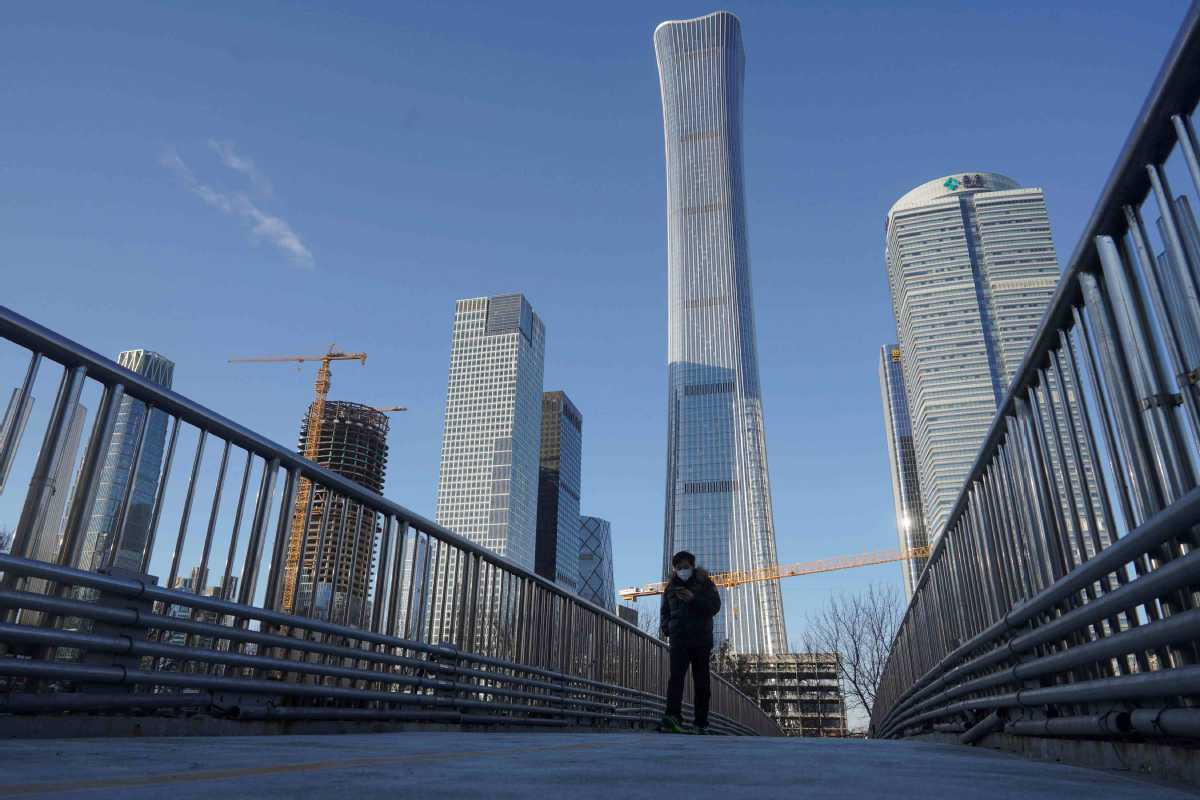
The novel coronavirus outbreak makes teleworking a safer choice for Chinese corporates and puts traditional office and coworking space under pressure in the short term, although business insiders said the sector will eventually stabilize.
Compared to the retail sector, which has been hit hard by the epidemic, commercial offices are feeling less overwhelmed in the past month as industry experts believe leasing demand for offices will be more cautious in the near term.
Currently, retailers are facing a consumption slowdown because of concern over human-to-human transmission of the disease. The office sector felt less impact than retailers since their clients are corporates scattered in various sectors, said Irwin Liu, director of the East China advisory service of Colliers International.
"Office rent usually accounts for between 5 percent and 10 percent of the operation cost of a company, lower than the retailer sector that ranges between 10 percent and 20 percent," Liu said.
"Office leasing activity in China is expected to slow in the first quarter of 2020. However, any impact should be short-lived, providing the virus remains relatively contained. Leasing activity is likely to recover as early as the second quarter," said Henry Chin, head of research for Asia-Pacific region and EMEA(Europe, the Middle East and Africa) of CBRE.
Due to sufficient supply, the office leasing market of major Chinese cities witnessed a significant rent decline in 2019. The vacancy rate reached 20 percent in Shanghai, 22 percent in Shenzhen and 13 percent in Beijing, said Cushman &Wakefield.
In terms of Grade A office rents, the four first-tier cities of Beijing, Shanghai, Guangzhou and Shenzhen reported a decline of 4 percent, 5.2 percent, 4.7 percent and 12.3 percent respectively year-on-year, JLL data showed.
The average rent of prime office in Beijing was 383 yuan ($54.7) per month/square meter by the end of last year. The level in Shanghai was 255 yuan, Shenzhen stood at 228 yuan and Guangzhou was at 175 yuan, said Colliers International.
"The current situation will slow down office expansion activities of enterprises and restrain rents from going upward," said Vicky Shen, who is senior director, head of the China office agency, and head of East China residential for Cushman& Wakefield.
Experts said the outbreak of the epidemic is likely to boost the vacancy rate and rents are likely to consolidate in the short run. They said the impact for office operators will largely depend on the risk resistance capability of their tenants.
"Those coworking space operators having startups and small enterprises as their core clients are more vulnerable and riskier, since small-and micro-businesses are under more pressure," said Shen.
On Feb 5, the municipal government of Beijing launched policies to relieve the pressure for small businesses such as rent cuts for small-and medium-sized enterprises, an extension on tax payments, the suspension of fee charges, along with grants to subsidiaries.
In Shanghai, the local government announced 28 measures to support enterprises that are battling the virus on Feb 8. This included rent relief for small-and medium-sized enterprises leasing office spaces located in State-owned industrial parks and office buildings.
"More local governments will follow suit to support enterprises going through the current difficulties. Therefore, the office market will continue to stabilize in the mid-and long-term," said Huang Lu, head of research for JLL East China.
"It's worth noting that the restraints on demand will be released in an accelerating speed after the disease comes to an end," added Huang.
A survey conducted by Colliers International on 475 landlords, tenants and investment institutions from 11 major cities including Beijing, Shanghai, Guangzhou, Shenzhen, Chengdu, Nanjing, Suzhou, Hangzhou, Shenyang, Dalian and Xi'an showed they are confident of a rebound in market demand in the second half of the year, making up for losses in the first six months.
Among the 337 tenants polled, 34 percent believe their companies will not be affected by the novel coronavirus, 19 percent expect some damages, and 26 percent replied they have felt the impact of the disease, the report said.
"About 85 percent of the office owners said they have not been reached by their tenants to surrender their tenancy. Enterprises from the gaming, online retail, online education and biomedical sectors are likely to seek an expansion," added the report.
"In the long term, we are optimistic toward the outlook of the epidemic being brought under control. As the impact of the novel coronavirus phases out, we are going to welcome a sharp rebound in demand," said Ge Haifeng, vice-president of China Index Holdings Ltd.
Although the ongoing epidemic offers an opportunity to test remote work from home by enterprises, it's not yet known how this solution can become acceptable. It is uncertain this would influence the physical leasing demand for office or coworking space, said Liu with Colliers International.
Cushman & Wakefield's Shen said the virus would challenge the operation and management of old office buildings. Operators could pay more attention to the safety and health of the working environment in their daily operations and offer more value-added services to meet the varied requirement of enterprises.
The Colliers International report suggested office landlords communicate thoroughly with their corporate tenants to avoid the loss of clients and negotiate favorable long-term leasing contracts so enterprises do not get the full impact of the epidemic.
For shared office brands whose major clients are medium-and large-sized corporates, their tailor-made working space offerings might attract more demand from multinationals and large corporations after the disease fades away, according to Liu.
"In the long-term, the outbreak could encourage more occupiers and landlords to place greater emphasis on employee well-being and sustainability," said Chin of CBRE.




















