Trump's 'xenophobia' against China, Chinese students and Huawei









Editor's note: Azhar Azam works in a private organization as a market and business analyst and writes about geopolitical issues and regional conflicts. The article reflects the author's opinions and not necessarily the views of CGTN.
Most of the U.S. problems are not China's fault. China is not going to collapse under its weight. China won't become a Western-style democracy, and America needs to look into its mistakes and failures, said former U.S. House Speaker Newt Gingrich in his recent book "Trump vs. China: Facing America's Greatest Threat."
Gingrich also stressed that China is not responsible for 89 percent of Baltimore's eighth-grade students' inability to pass their math exams or the dramatic increase in Chinese graduate students in science. China didn't guide the U.S. defense bureaucracy to create a "military-industrial complex," and there is every reason to believe that China has been catching up rapidly and could outpace America soon.
Trump's supporter underscored that China is not the reason old and entrenched U.S. companies could not develop a global strategy for 5G over 11 years and extolled Chinese company Huawei for working hard to become a world leader in wireless technology. He also said that by providing better services and more advanced equipment Huawei is poised to win the global 5G race through Chinese spending of 8-10 billion U.S. dollars since 2015.
These are the comments made by a harsh China critic who has accused Beijing of "routinely sign things then cheats."
The question remains, if China was not responsible for the U.S.' failure to match its bureaucratic, scholastic, military, economic and technological growth, as Gingrich described, why are the Trump administration and the U.S. Congress wailing about Beijing?
It appears as if the U.S. has succumbed to China and is now trying to compete with it unfairly by redoubling U.S. efforts to push Beijing back through blinkered moves, including slapping on tariffs, curbing its tech giants and wreaking havoc in Chinese internal affairs.
The U.S. is also deeply threatened by Chinese graduates studying in America, particularly in the areas of robotics, aviation and high-technology manufacturing. In June, the U.S. president put limits on visas to Chinese students, saying they are a national security risk for the country over "intellectual property theft" by Beijing.
Although he said he would "be very good to Chinese students during an interaction with Chinese journalists in White House on October 11, the Chinese Ministry of Education's first quarter 2019 data, showing a 13.5 percent rise in declined Chinese student visa applications from 3.2 percent in 2018, refutes the president's claims.
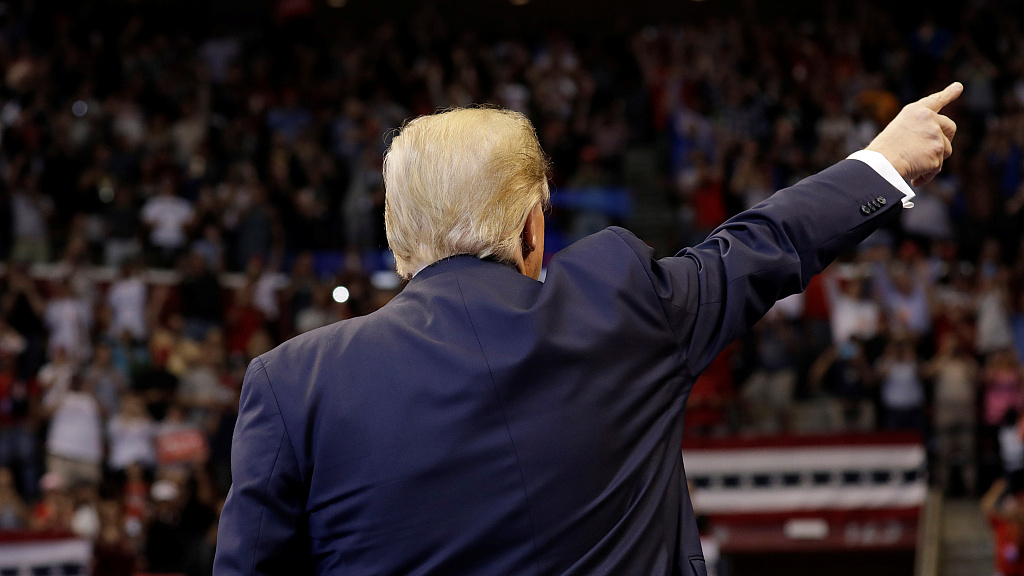
Donald Trump on stage with Newt Gingrich, former speaker of the U.S. House of Representatives, during a campaign event in Cincinnati, Ohio, U.S., July 6, 2016. /VCG Photo
Since the statistics further disclosed that nearly all the visa rejections were for Chinese students going on state-sponsored scholarships, the special treatment of Chinese STEM (Science, technology, engineering and math) graduates suggest America's exasperation toward Chinese technology growth, which was replicated in its stringent regulatory measures on Huawei and other companies from the Chinese mainland.
But the U.S. seriously underrated Huawei's strength. Before the U.S. government imposed restrictions on American companies that supply components for Huawei products, the Chinese tech giant preempted the forthcoming checks from the Trump administration and was well-prepared with a backup plan in its quest to "stand on top of the world."
Huawei and others immediately unveiled their most-advanced domestically built chips to reduce their reliance on American semiconductors. At the Internationale Funkausstellung Berlin (IFA) consumer electronics show in Berlin, Huawei presented the new Kirin 990 all-in-one artificial intelligence and 5G chip. Later, the conglomerate started to sell the other Balong 711 4G chipsets to third parties.
The U.S.' obdurate curbs did not make any impact on Huawei revenues either. Its smartphone shipments hit 200 million units, two months earlier than it did in 2018. Just a week before, the electronics heavyweight jolted the global tech industry when it stated that it generated 24.4 percent more revenue compared to the previous year while its U.S. competitor Apple saw a double-digit decline in the third quarter of 2019.
Six months after the U.S. launched a tech war against China, the Trump administration is scratching its head rather than regulating the largest manufacturer of the telecommunication equipment and second-largest mobile phone supplier worldwide.
The U.S. government is so topsy-turvy that on one side its commerce department extended a third 90-day reprieve to Huawei, allowing American companies to do business with it. However, on the flip side, the U.S. Federal Communications Commission (FCC) barred its 8.5 billion U.S. dollars a year Universal Service Fund (USF) from purchasing equipment and services from Huawei and ZTE.
While the FCC aimed to marginalize the two Chinese companies by preventing them from taking part in the procurement process, the commerce department's third extension to Huawei implies that the U.S. is finding it increasingly problematic to find a better supplier that could meet the cost and quality offered by Huawei. It could also be because American firms were expected to suffer a loss of 14 billion U.S. dollars on account of the semiconductor chips and other components to be sold to Huawei.
Following its embarrassing failure to impede Huawei's growth, Washington is taking yet another insular line to impede Huawei's growth by raising the self-styled specter from a Chinese firm in the upcoming NATO meeting. It is also reportedly weighing to influence foreign suppliers to cut off supplies to Huawei.
But the U.S. would never be able to dictate international supply chains that are not constrained to bow to American hegemonic behavior at the cost of their national and business interests. Also, the current regulations do not permit any country the authority to block Huawei's shipments other than the U.S.