



Manipulation charge does not make economic sense









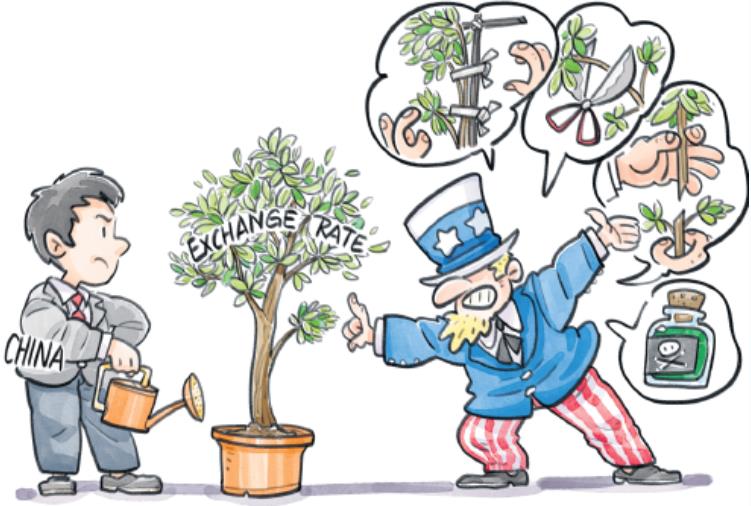
For the past two years, the value of the yuan has been closely linked to that of the euro, so the accusation that China is manipulating its currency to stimulate exports is not supported by the data - unless the European Central Bank is also being accused of currency manipulation. What has actually been happening is that the US dollar has been rising against other world currencies.
Furthermore, a policy of driving down the value of the yuan would make no sense from the point of view of Chinese economic strategy. Hypothetical currency manipulation would, if implemented, raise inflation in China by raising the price of its imports, force China to buy more very low-yield US Treasury bills, and would be an ineffective way to boost exports.
The accusation of currency manipulation is vague, with no clearly stated time period. So, let's examine the last few years.
On August 5, 2019, the date on which the US Treasury declared China to be a currency manipulator, 7.89576 yuan was traded for one euro. Exactly a year earlier, on August 5, 2018, the yuan/euro rate stood at 7.96328. So, the yuan actually rose 0.47 percent over that year. In the previous year, from August 2017 to August 2018, the yuan fell 0.85 percent against the euro. So, for the past two years, the yuan has been basically flat against the euro, with some normal fluctuations.
The value of the yuan compared to the euro rose sharply in 2014, which was a fairly high-growth year for China. From early 2015 to mid-2017, the yuan gradually fell against the euro, since that was a slower growth period in China. The yuan is now higher, compared to the euro, than it was five years ago.
The data shows that the value of the yuan compared to the euro has behaved exactly as market forces would predict.
In the same five-year period, the euro fell 8.4 percent against the dollar. Before the US announced that it would impose a 10 percent tariff on an additional $300 billion worth of imports from China, the yuan had fallen 8.9 percent against the dollar over five years - almost identical to the decline in the value of the euro with respect to the dollar.
Immediately after the announcement of the new tariffs on Thursday, Aug 1, the yuan fell an additional 2.2 percent relative to the dollar by the close of the markets on Monday Aug 5. The yuan/US dollar has been basically flat since then. This is exactly the response that any market participant would have predicted to the new tariffs. It indicates the opposite of currency manipulation.
China's current account surplus was 1.549 percent of GDP in the first quarter of this year, after having fallen to a deficit of 1.095 percent of GDP in the same period last year. This roughly balanced global current account is further evidence that the value of the yuan is at the level that would be determined by markets.
But, suppose we just ignore the real data and assume, counterfactually, that Chinese monetary authorities want to manipulate the value of the yuan. Would such a policy be beneficial for China? Absolutely not.
It's possible that a country might want to lower the value of its currency in order to stimulate exports by lowering the dollar price. But this makes no sense for China now.
Since the tariffs are imposed both on the Chinese value-added and on the re-exported value, they will raise the prices of some Chinese goods to US consumers. But, lowering the value of the yuan would not counteract the tariffs because much of the end-price of those goods is not determined by Chinese costs.
According to the Organization for Economic Cooperation and Development data, in 2015 the Chinese domestic value-added share of export value was 55.3 percent for information and communications technology and electronics exports and 50.8 percent for textiles and apparel. These are the two largest categories of Chinese exports to the US.
So, although Chinese value-added has been rising, it is reasonable to assume that roughly 50 percent of the value of exports to the US consists of re-exports of components and material bought from third countries.
So, the 2.2 percent drop in the value of the yuan results in only a 1.1 percent drop in the price of Chinese exports at the port of export.
Plus, at least half of the US retail price of China's exported products goes to US logistics companies, wholesalers, marketers, retailers, etc. So, the 2.2 percent drop in the value of the yuan would result in only a 0.55 percent drop in the retail price of the product in US stores - an insignificant amount.
It is ridiculous to claim this small drop in the value of the yuan could be currency manipulation.
The US goal is to shift production from China to other countries, such as Vietnam, Bangladesh, or Ethiopia. Labor intensive manufacturing is not going to move back to the US.
Low-wage manufacturing is already leaving China as part of the long-term upgrading of the economy. More sophisticated manufacturing depends on industrial clusters with specialized skilled labor, more advanced technology and good infrastructure, so it is unlikely to leave China.
Also, lowering the value of the yuan would cause inflation within China by raising the yuan-price of goods imported into China. Especially, the yuan-price of petroleum, which is traded internationally in dollars, would go up. So, the cost of an artificially low yuan would be high for Chinese consumers.
No country, including China, can just arbitrarily set its exchange rate. To manipulate its currency, a country would have to affect the global demand and supply for that currency.
If China were to try currency manipulation, it would need to change the value of the yuan compared to the dollar. This means that it would have to shift the worldwide value of the dollar. That is, to lower the value of the yuan, Chinese policy makers would have to raise the value of the dollar.
How might this conceivably be done? China would have to buy lots, at least hundreds of millions of dollars worth, of US Treasury bills, which pay very low interest rates. That is, China would have to make a very low interest rate long-term loan to the US government. This was done in the late 2000s when China was running large trade surpluses, but it is not happening now and China is unlikely to want to do this in the future.
Bottom line: The accusation that China is manipulating its currency is not supported by the data or by economic logic.




















