Digital health technology empowering doctors, patients









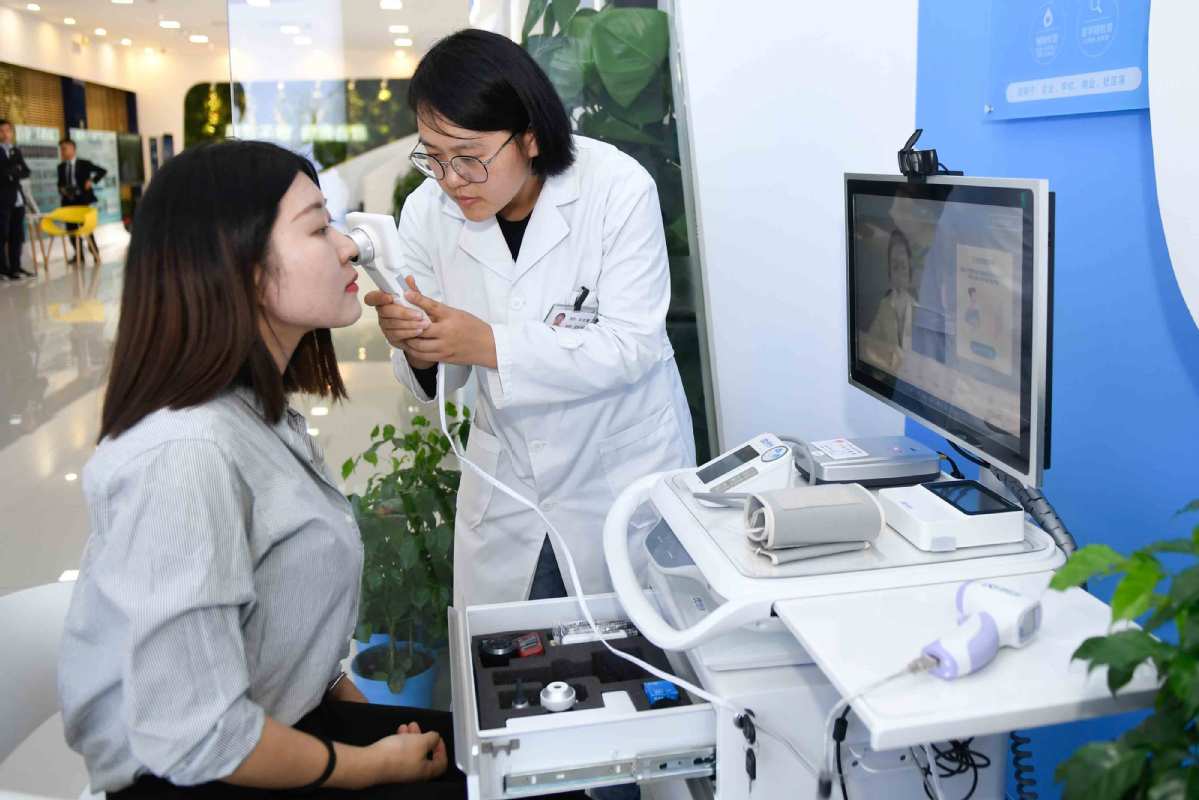
Once-futuristic scenes of doctors conducting operations on patients via remote-controlled equipment are becoming a reality in China.
In April, a patient suffering from heart disease in Gaozhou, Guangdong province, was saved through remote surgery that was supported by 5G technology.
During the procedure, which lasted about three hours, a surgeon in a Gaozhou hospital wore a probe that transmitted ultra-high-definition pictures to a display at a top hospital 400 kilometers away in Guangzhou, where experts used 5G livestreaming to give real-time instructions to the surgeon.
In March, a physician in Sanya, Hainan province, manipulated surgical instruments with micron precision on a computer through a 5G network, and successfully placed a deep brain stimulation implant in a Parkinson's disease patient 3,000 kilometers away in Beijing.
And in December, a Chinese doctor using a 5G network manipulated a surgical robot 50 kilometers away to successfully remove hepatic lobules from a small pig.
Digital health technology is increasingly part of everyday healthcare for professionals as well as patients in China, according to Future Health Index 2019, a report on digital health by health technology company Royal Philips.
The report concluded that China has leapfrogged other countries in adoption of digital health technology, based on a survey of more than 15,000 individuals and over 3,100 healthcare professionals in 15 countries, including the United States, the United Kingdom, Australia and France.
China significantly outperformed the 15-country average on use of most of the key technologies examined, the report said. Other leaders in digital health include India and Saudi Arabia.
Ninety-four percent of Chinese health professionals reported using digital health technology or mobile health apps, followed by India, with 88 percent, and Saudi Arabia at 85 percent. The average of the 15 countries was 78 percent.
About 81 percent of Chinese in the survey said information they received from digital health technology or mobile apps led them to contact a healthcare professional, compared with the average of 47 percent for all 15 countries.
Chinese also surpassed the 15-country average when it came to tracking key health indicators with digital health technology, such as blood pressure, heart rate, diet, weight and physical activities.
In addition, 44 percent of Chinese said that, given the choice, they would prefer a remote consultation with their doctor via a digital channel for nonurgent care, while the 15-country average was 27 percent.
China has also led the share of global investment and financing in the field of artificial intelligence between 2013 and the first quarter of 2018, with 60 percent of the global total, followed by the US(29 percent) and India (5 percent).
"I cannot imagine how inconvenient it would be if all the healthcare apps and WeChat accounts I've been using were not available," said Cynthia Liu, a 30-year-old Beijing resident.
Some of the apps and WeChat accounts she uses were created by hospitals. She can acquire information about a doctor, make appointments, get access to online medical reports and pay medical bills online.
"Whenever someone in my family feels ill and wants to see a doctor, my first choice is always these online healthcare services. They are very convenient and time-saving," she said.
According to a report earlier this year by CEC Capital, the development of big data, artificial intelligence and other digital technologies can provide more insight into and improve the transparency of medical services, and thus will boost the digital healthcare market. Such developments also will transform the connection between doctors and patients, while making remote diagnoses as well as intelligent diagnoses and treatment possible, the report said.
WeDoctor, an online healthcare startup launched in 2010, said its digital healthcare platform has connected with 2,700 hospitals and 290,000 doctors and has served 190 million patients.
The medical portal DXY, founded in 2000, said its users have reached 80 million, including 2.1 million doctors.
Big internet companies are also increasingly involved in digital healthcare.
Tencent Trusted Doctors, the medical arm of internet company Tencent, has more than 450,000 doctors on its online platform, nearly 40 offline clinics, six ambulatory surgery centers and more than 4,000 intelligent machines, providing online-to-offline healthcare services.
Patients at its offline clinics can hold long-distance, high-resolution video calls to consult with experts registered on its online platform, and patients' family members can join video calls via WeChat.
The company's Intelligent Health Terminal is like a vending machine, providing checkup appointments and a variety of convenient and noninvasive self-testing products, such as urine, pregnancy and genetic tests.
Wang Shirui, CEO of Tencent Trusted Doctors, said digital technology is improving healthcare in China, empowering patients and doctors alike.
However, the Royal Philips report said healthcare professionals in China are not harnessing the full potential and support of digital technology in all aspects of their work, although some are adapting to new ways of working and beginning to recognize the benefits of digital healthcare for themselves and their patients.
Zhao Heng, the founder of consulting company Latitude Health, said protection of patients' privacy in the use of digital health services remains an urgent issue in China, since the country has no specific law to regulate the acquisition and commercial use of patients' digital information.
In addition, he said, few online health companies in China have established profitable business models, which will hinder the further development of digital healthcare in China - despite the wide application of digital technology and the convenience it brings.
Ma Si contributed to this story.






- Extreme weather conditions forecast during gaokao period
- Millions vie for college spots as reforms boost fairness and opportunities
- Xi receives visit from Panchen Rinpoche
- China's northern, southern regions enter flooding season in June
- Xinjiang celebrates Corban Festival with feasts and traditions
- Chinese courts step up handling of maritime cases