China's advances in astronomy to bolster talent development









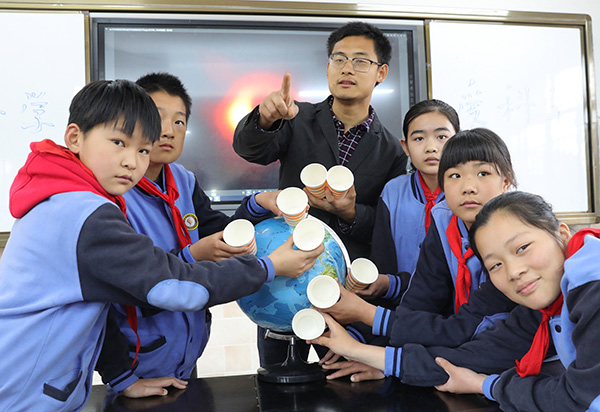
The rising number of large equipment for astronomical observation and research and international projects where China is playing a leading role are expected to help more Chinese students join this field, according to experts. Such large equipment and projects have given many students an opportunity to experience the implementation of scientific agendas and perform device maintenance and computational operations, activities that were rare in China until a few years ago.
Xue Xun, a professor from the School of Physics and Materials Science at East China Normal University, cites the Five-hundred-meter Aperture Spherical Telescope, or FAST, as an example, in an interview with China Daily.
The world's largest telescope located in Southwest China's Guizhou province began operation in 2016.
"Such large world-class scientific equipment allows young students to be involved in execution, information gathering and calculation on the front line together with top scientists," Xue says.
FAST has discovered dozens of pulsars since its operation, and the discovery of the first pulsar by British scientists in the 1960s was a breakthrough that led to the winning of a Nobel Prize, says Xue.
China also has other large equipment and projects such as the Tianqin program, a space-based gravitational wave detection system scheduled to be completed by 2035; Taiji research project, which will study gravitational waves from the merging of binary black holes and other celestial bodies; and Ali, a ground-based project in the Tibet autonomous region that aims to detect the first tremors of the Big Bang.
"More astronomical telescopes of various types will be launched in the next few years," Xue says. "Astronomy has flourished over the years. The need for professional talent is indeed rising."
Scholars also point out that breakthroughs in astronomy, such as China's dark matter particle explorer Wukong, or Monkey King, which was put into operation in 2016, and the detection of gravitational waves from black hole mergers or collisions by the Laser Interferometer Gravitational-Wave Observatory, or LIGO, in the United States that same year, have attracted more people from the younger generations to pursue knowledge in this area.