Belt and Road set to 'transform' global economy









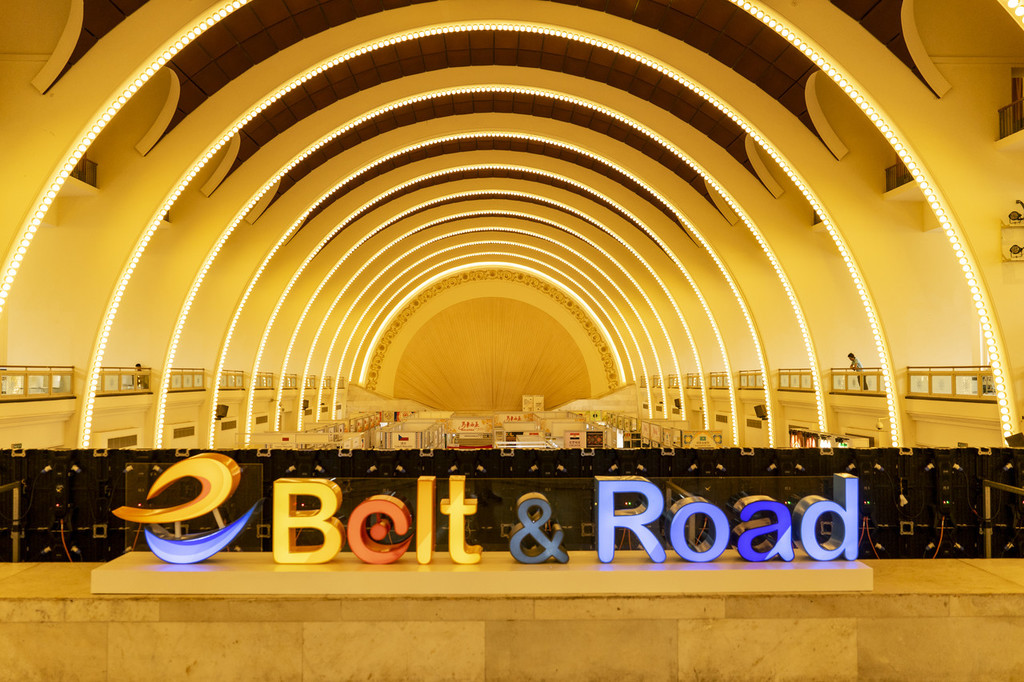
Initiative likely to raise world GDP by 4.2 percent in 2040, major economics report says
China's Belt and Road Initiative is likely to boost world GDP by $7.1 trillion annually within the next two decades, involving up to $8 trillion of spending over the next quarter century via global infrastructure and other related projects, according to the latest figures from a major economics report.
The initiative is likely to raise global gross domestic product by about 4.2 percent in 2040, or 8.3 percent of GDP this year, with up to 56 countries forecast to have their annual GDP in 2040 boosted by more than $10 billion as a result, the report from the London-based Center for Economics and Business Research consultancy showed.
Laying out some of the most detailed benefits of the BRI so far, the center's 40-page report, "From Silk Road to Silicon Road: How the Belt and Road Initiative will Transform the Global Economy", was written for the Chartered Institute of Building worldwide professional body representing construction and property professionals. It was provided to China Daily ahead of its public release this week.
The BRI "is the most ambitious and largest infrastructure project arguably in history and will eventually touch more than two-thirds of the world's population across some 65 or more countries. Its impact and effect will be felt for generations", the institute's president, Chris Soffe, wrote in the report.
"Although currently the BRI has about $2 trillion of projects already on the drawing board, we believe that as it succeeds it will expand to encompass many other projects," reported the center, which analyzed the economic impact of transport and infrastructure, as well as trade frictions in its study.
The center identified a wide range of additional projects that seemed likely to link with the BRI, including a "green belt and road" global network of renewable energy sources and storage, upgraded highway links catering to autonomous vehicles, and an academic network connecting universities and scientific research with potential long-term impacts on technology and productivity.
Other than China, which by 2040 will be by far the world's largest economy and which will therefore benefit from any boost to the world economy, the "biggest single potential beneficiary" of the initiative "is likely to be the US, even though it isn't participating directly in the project. This is because of the sheer size of the US economy, which means that it gains from the indirect effects of world GDP being boosted", according to the center.
"So bizarrely, despite the opposition of at least the Trump administration, the United States is positioned, potentially, to be the second-biggest beneficiary of the Belt and Road Initiative," CEBR Founder and Deputy Chairman Douglas McWilliams told China Daily.
Amid a "rebalancing of global power", McWilliams said he would expect the US to "come to terms" with the impact and success of the BRI and "may eventually want to participate in it".
The regions that will most be transformed by the initiative are likely to be Central Asia and Russia, where GDP in 2040 is forecast to be 18 percent higher, and likely to be boosted in Central Europe (6 percent), Western Europe (5 percent) and East Asia (5 percent), according to the report. The largest proportional impacts are expected to be in Mongolia, Kyrgyzstan and Russia, it said.
It is also highly likely that the Western European end of the BRI, which has, other than Greece and the recent accession of Italy, "largely stayed aloof so far", will join in as the project gains momentum and attracts more countries, according to the center.
But the center also identified risks and obstacles for the projects. Other than "the normal economic, political and military risks, which always have to be taken into account", there also were risks that "relate specifically to the projects themselves. They are at the cutting edge of technology and as a result who can tell what technological obstacles might emerge", it said.
There also were economic obstacles — if the global economy "develops more slowly than expected, there is a risk that either lenders or borrowers might face debt obstacles which would constrain the pace of spending", according to the center.
Peter Frankopan, professor of global history at Oxford University, told China Daily that the challenge for the BRI at the moment "is to focus on the detail of each project in turn as each can and should be measured by different metrics. Some projects are more complicated than others because of geography, scale, length of completion and outcome, and of course some carry higher levels of risk too".
There was also the obvious concern about "the over-dependence and even the perception of over-dependence on China", said Frankopan, whose new book, The New Silk Roads: The Present and Future of the World, looks at the links and interconnections along the routes today.
"All countries like to have options and choices, and one of the difficulties at the present is finding a way that international relations between states does not become a question of division. In my opinion, this is why greater collaboration, greater integration and greater multilateral cooperation is not just useful but essential as BRI develops — which is something President Xi Jinping often talks about," Frankopan said.
In its report, the CEBR likened the BRI to the vast road network of the Roman Empire that "eventually mainly existed to support and enhance trade".
"The key point of the BRI is not just the physical and electronic infrastructure but the extent to which it makes trade around the world easier," it said.
Through the BRI, China will be "continuing to drive world economic growth" by "helping the building of infrastructure throughout the world and through reducing both transport and other frictions that hold back world trade", according to the center.
Given China's financial capabilities, willingness to invest in other countries, and its capacity to encourage cooperation, "there are many benefits to populations not numbering in millions or even tens of millions, but in hundreds of millions and billions if successful projects that are financially, socially and environmentally sustainable are implemented", Frankopan said.
"That will not just change the world for the better now, but will do so for future generations too," he said.