



New forests halt desertification









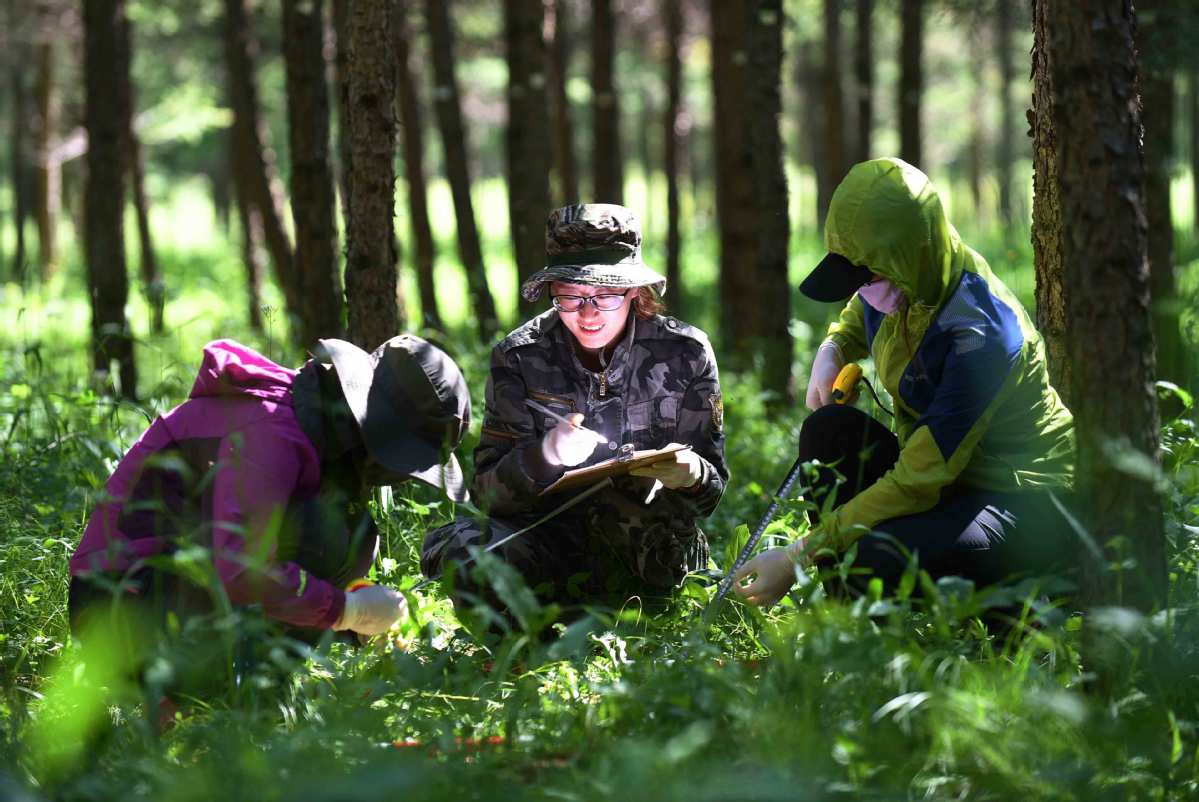
Battle in Saihanba
Similar forestation and desert control projects have been witnessed at the Saihanba Forest Park in Hebei province and in the Kubuqi Desert in the Inner Mongolia autonomous region, which are located to the northeast and northwest of Beijing, respectively.
Three generations of forest park workers have created 7.47 million hectares of artificial forest out of a semidesert.
Chen Yanshu, 75, was one of the first five female workers to arrive in Saihanba in 1964, when she was 20.
"The lowest temperature in winter was -40 C, and the conditions were very harsh. I was motivated by the country's first female tractor driver, Liang Jun, and wanted to be like her. So I volunteered to go to places where I was needed by my nation."
Ren Zhongyuan, Chen's coworker, said: "Our saplings could not survive the cruel conditions. The rate of survival was 5 to 8 percent at first, so we did experiments and grew seedlings to make sure they could adapt to the environment. We adapted tree-planting machines to suit the local conditions."
Shi Chen, whose father and grandfather worked all their lives at the Saihanba Forest Park, went there after graduating with master's degrees in forestry.
"I grew up here, and I am emotionally attached to the woods. I think it is worthwhile dedicating my youth to the land as my father and grandfather did," Shi said.
The park now has more than 1,000 species of insect, over 700 types of plant, 256 animal species and 192 types of bird.
Kubuqi model
The Kubuqi Desert in northern China, the nation's seventh-largest, covers 13,900 sq km south of the Hetao Plain. Over the course of 30 years, thanks to support from the government, local people and enterprises, about 6,300 sq km of desert have been covered by grasses, shrubs and trees.
Locals plant herbs and erect solar panels to increase their income, and more than 100,000 residents have been lifted out of poverty.
The success of desertification control in Kubuqi has been termed the "Kubuqi model", and features concerted efforts by multiple parties.
Gao Eryun, a farmer in Guanjing village, Kubuqi, remembers how his father Gao Linshu - the given name means wood and tree - cherished a willow tree he brought to the village.
Gao Linshu was known for making that first tree in the region survive, for a few years at least, in the 1950s.
Gao Eryun said the local government played a crucial role in encouraging the farmers to contract barren land and plant trees in 1981, promising them they would own everything grown on the land.
While other farmers adopted a wait-and-see attitude, Gao Linshu became the first person to contract 133 hectares of sandy land to plant trees.
Gao Linshu traded two of his 10 sheep for a mule cart full of willows.
"He spent most of his time planting the trees in the sand. He was crazy about planting trees for years," Gao Eryun said.
By 1986, Gao Linshu had planted willows over an area of about 35 hectares. "He looked after the trees as if he was caring for a baby," his son said.
Gao Linshu planted some castor seeds later to obtain castor oil. On one occasion in 1990, when the average per capita annual income was about 300 to 400 yuan, he made 18,000 yuan from selling the oil.
He also volunteered to help locals who contracted barren land from the government. In 2000, the local government started to give farmers willows to plant for free. The tree planters were provided with subsidies.
By last year, the Gao family had turned 220 hectares of sandy land into woods, shrubs and grassland, and the village is now at the center of a 7,000-hectare oasis.
Local farmer Zhou Qiang, 36, moved back to his deserted home in Kubuqi four years ago to run a hospitality business to meet the rising tourist demand - there are now more than 20 tourist spots in Kubuqi, including Qixin Lake.
Zhou previously worked as a migrant worker in neighboring Dalad Banner for more than 10 years.
"There used to be no water, electricity or telephones. The corn grown on the barren land was barely sufficient to feed the sheep. There was no way out," Zhou said.
His home lies in the middle of a 50-km pathway across Kubuqi, and he can cater to more than 1,000 visitors a day in the peak tourist season.
Thousands of local families are earning a living in the catering and service industries.


- Xi urges major provincial economies to gain experience in solving new problems
- Professional managers key to rural vitalization, expert says
- Chinese clinical trial shows breakthrough in liver cancer survival
- Alibaba committed to AI advancement amid leadership shake up
- Rapeseed flowers bloom in Guizhou, heralding spring visitors
- Chengdu High-tech Zone celebrates Lantern Festival with AI, talent showcase





