Seeing the light in a land of darkness









A young graduate from Wuhan recounts his sense of wonder after working at the bottom of the world, Wang Ru reports.
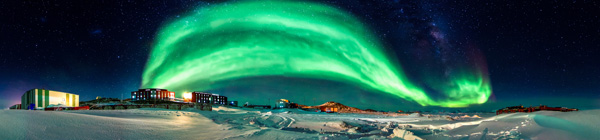
Li Hang had an experience that you could say lit up his life. The PhD graduate from Wuhan University saw the light in the South Pole, the aurora australis.
"I was astounded. It seemed to move like a swimming whale. But it comforted me emotionally, relieving my solitude and dullness. I thought it was a gift from heaven."
He photographed the natural phenomenon. Auroras are produced when the outer sphere of the atmosphere is disturbed by solar wind. He has more than 100,000 photos of the scenes he witnessed during the approximately 500 days he spent at the bottom of the world.
Li was not on a pleasure cruise. He was working hard as part of China's 31st and 32nd polar expeditions to the South Pole. At the time he was pursuing a doctoral degree on survey engineering at the Chinese Antarctic Center of Surveying and Mapping, Wuhan University. He stayed in Antarctica from October 2014 to April 2016, and some of his photos were published last year by leading publications in the field, Nature magazine in Britain and Science magazine in the United States.
Li's laboratory has a long-term project which sends students or teachers to the South Pole every year for scientific investigation. He signed up for it immediately when offered the opportunity. He says he was "lucky" to be chosen in early 2014 and then received training before he embarked on the journey at the end of that year.
Normally, China's Antarctic teams are separated into two groups. The first, with 200 or 300 people, stays only during the relatively warm "summer" season (roughly November to January). The other group stays longer for the winter but has just dozens of people.
Li and his group members spent most of their time at the Zhongshan scientific research station. He says the temperature there can reach 1 C to 4 C in the warm season and-40 C to-30 C in the cold season.
"The polar day (when the sun does not set) happens in the warm season and lasts for about two months. During the time examiners were busy completing more tasks. But we lived a slower pace of life in the cold season, especially during polar nights, for safety considerations," says Li.
They were busy there, he says, since they had to do everything by themselves besides their obvious scientific tasks, like cooking, cleaning and disposing of the rubbish.