Internet helps channel medical resources from city to rural areas









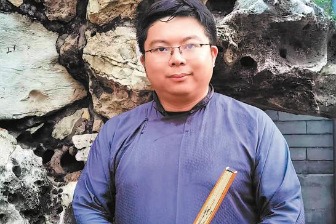
Doctor Huang Hongji has been running the health rooms in Dalang village in northern Guangdong province since he graduated from a local health school in 1993.
The 47-year-old didn't get a doctor's qualification until 1999, and could only handle minor illnesses such as colds and coughs. For more serious illnesses, villagers had to seek medical expertise from the urban area about 10 kilometers away. Some even had to travel to Guangzhou, the provincial capital.
That began to change after Guangzhou-based Guangdong Second Provincial General Hospital launched a program in 2015 to help connect rural residents with urban medical resources through the internet.
An account allotted to each of the 159 villages, including Dalang, allows village doctors to get in contact with doctors from the county-level hospitals for help solving diagnostic problems. More complicated cases can be referred to the provincial hospital itself.
The hospital in Guangzhou also developed devices that can be worn by patients to measure crucial data, including blood pressure and heart rate. The data can be transmitted to the hospital immediately, where experts could confirm the diagnosis.
According to the hospital, the device can recognize 90 percent of the most common diseases at community hospitals.
Huang said the three-way communication involving patients and medical experts has helped him hone his diagnostic skills, which benefits villagers.
"Most of the village doctors had limited professional training, and some had no training at all," he said, adding that by comparing his own diagnosis with those made by experts, he has made rapid progress.
Zhang Gangqing, director of the medical department at the Guangdong Second Provincial General Hospital, said the capacity of rural medical practitioners is yet to be improved, so rural residents' healthcare is also lagging.
Zhang now heads a hospital in Yangshan county, where Dalang is situated, in a paired assistance program. He noted that the poor rural infrastructure means that few talented doctors go to the countryside.
"Many village doctors work part time because the position usually cannot provide a living," he said, adding that the government subsidies - less than 20,000 yuan a year in Guangdong province - are still far from enough considering the income of their urban counterparts.
There were 968,600 village doctors in China as of 2017, according to the National Bureau of Statistics, down from 1 million a year before, whereas the number of medical professionals increased nationwide to 8.98 million from 8.45 million over the same period.
Tian Junzhang, president of the hospital, said the program has helped bring quality healthcare services to remote regions at manageable cost.
But despite the progress, Tian said, the obstacles persist. The lack of internet coverage has slowed the expansion, and the increasingly elderly rural community - mostly left-behind seniors whose children work in cities - and the accompanying knowledge gap have posed a challenge to the use of the high-tech medical services.
"We have organized five training sessions targeting rural doctors, most of whom are seniors themselves," he said.
The National Health Commission released a circular in December urging the sector to help win the battle against poverty between 2018 and 2020.
It urged hospitals to share medical resources through the internet, and use the model to provide medical services, including chronic disease management and rehabilitation, to rural residents.
Illnesses and the resulting medical expenses have been a major cause of extreme poverty. China has pledged to eradicate extreme poverty domestically by the end of 2020, in time for the centenary of the Communist Party of China.
Last year, the task was listed as one of the "three tough battles" that China must win in the next three years, along with preventing financial risks and tackling pollution.