



Far side of the moon not so far anymore









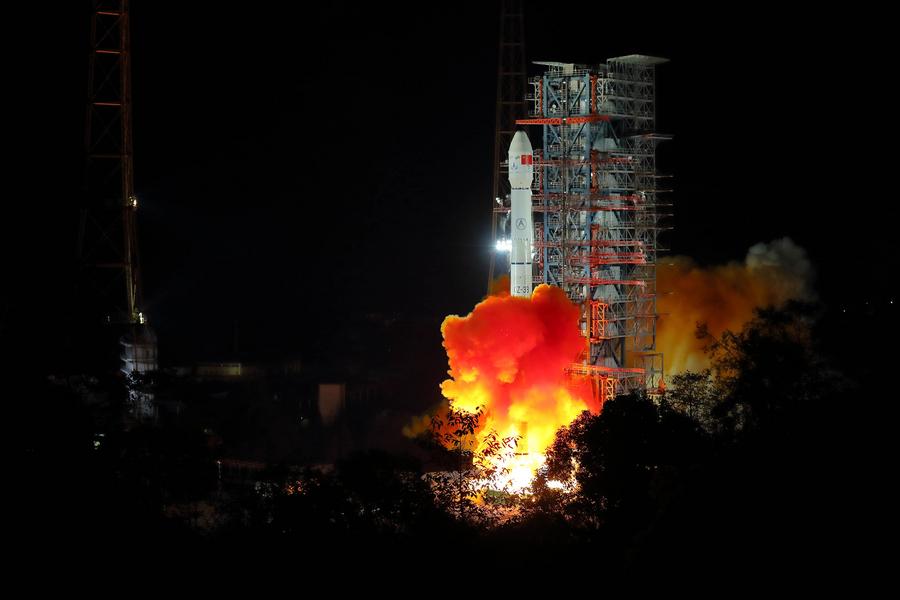
On Thursday, China wrote a new chapter in the history books when it successfully landed a spacecraft on the far side of the moon. The country achieved a global first when the robotic probe Chang'e 4 touched down at 10:26 am Beijing time in the largest and deepest crater on the moon's surface, the yet unexplored South Pole-Aitken basin.
This historic journey began 26 days ago at the Xichang Satellite Launch Center in southwestern China's Sichuan province, when Chang'e 4 was lifted atop a Long March 3B carrier rocket on Dec 8. Four days later, the rocket entered the lunar orbit and began preparing for the landing. Although the spacecraft could have tried to land on the moon earlier, Chang'e 4 needed plenty of sunlight as it is solar-powered. The far side of the moon, contrary to misconception, is not always dark. It has days and nights just like Earth; the only difference is that it has 14 Earth days of daytime and 14 of nighttime.
The biggest hurdle Chang'e 4 faced was the topography. The terrain of the far side of the moon is much more complex and rugged than the near side. Landing the rocket safely was a challenging job. It had to precisely adjust its speed and position and use its hazard-avoidance equipment for the perfect landing. Overcoming all these obstacles was not a small achievement to say the least. Prior to China's record-setting feat, the closest anybody had ever come to reaching the far side was when NASA crashed its Ranger 4 probe into the surface in 1962.
So why did China decide to go where nobody has ever dared to go? The first reason is that this provides unprecedented access for scientists to study the early history of the moon and the planetary system. While the far side has been photographed since the Soviets launched a probe in 1959, this is the first time that researchers will have an opportunity to learn about the moon from up close. By testing the soil of the far side of the moon, the mission is expected to provide insight into the birth of the moon and the start of the solar system.
The second is to study radio waves coming from deep space. Scientists using Earth-bound radio telescopes face lots of interference, such as shortwave broadcasting and TV and telephone signals. But the far side of the moon offers a completely noise-free environment, which means astronomers can pick up the faintest of signals.
The third is to explore whether sustainable life is possible on the moon. India, Russia and the US all are working on lunar exploration programs of their own. Similarly, China also wants to test whether humans can stay on the moon for an extended period. A crucial part of this is to study how water is created and distributed on the moon. And this is precisely what Chang'e 4 plans to do. If the mission is successful in finding a way to harvest water on the moon, instead of carrying it all the way from earth, then a longer stay on the planet will become easier.
Apart from these goals, Chang'e 4 is one part of China's continuous march in space exploration. The first major step China took in space exploration was the launch of the first satellite – Dongfanghong 1, on April 24, 1970. That launch gave China entry into the exclusive "space club". Then, in 2003, it became the third nation in the world to send a manned spacecraft with the launch of Shenzhou 5. In 2013, it achieved a "soft" landing on the moon after the journey of 2 million kilometers with Chang'e-3.
With the successful landing of Chang'e 4, China has achieved a new milestone. The opportunities are endless and the journey has just begun.
The author is a journalist with more than 18 years experience in media.





