


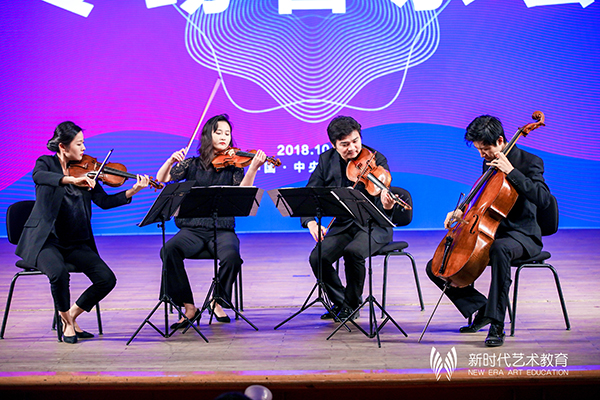
The Exchange and Cooperation Forum for International New Era Art Education was held at the Central Conservatory of Music in Beijing late last month, bringing together the heads of music schools, educators, musicians and students from countries including France, Spain, the United Kingdom and Ukraine, in an effort to share the collective experience of art education and promote future exchange programs.
The forum opened with a gala concert featuring the award-winning Amber Quartet performing Bela Bartok's Romanian Folk Dances rearranged by cellist and quartet member Yang Yichen, followed by The Beautiful Nalati Grassland composed by Liu Chang and performed by the Plucked Instruments Ensemble of the Central Conservatory of Music, and The Desert composed by Wei Jun and performed by guzheng player Hu Xuyuan and percussionist Bai Kai.
The forum led to the foundation of the Sino-European Alliance for Educational Cooperation in the Humanities and the Arts, a platform for international art education cooperation, and the creation of an international youth art and education center in Hainan province, according to Dong Songtao, vice-president and secretary-general of the International Education Committee of the Chinese Society of Educational Development Strategy.
"We've been having Chinese students to study at our school for 20 years, and they have introduced us to Chinese culture," Helene Rasquier, a professor at the Music College of Paris Normal University and a pianist and composer, told the forum. "Those Chinese students returned to China and became teachers. The education they gained in France was different to the one they would have received in China. The different influences provided them with a broader vision."
A keynote speech was given by Zheng Quan, a committee member of the International Violin Masters Association, who was sent to study the craft of violin-making in Italy between 1983 and 1988 before returning to China in 1989 to head the first violin-making research center launched by the Central Conservatory of Music.
"Violins made in China used to be seen as just toys," the 68-year-old said in his speech, "but after 30 years of effort, nowadays people look at us Chinese violin makers with respect."
Zheng is widely credited with training most of China's top talent in the field. So far, more than 200 students have graduated with a major in violin-making from the Beijing conservatory, and many of his students have won top prizes at prestigious international competitions for violin-making.
"When I studied in Italy, my teacher told me that the techniques behind making violins could be learned in the classroom, but he asked me to go and observe ordinary Italian people, at church, in restaurants or just going about their daily lives," Zheng recalls.
"Chinese people are smart and good with their hands. What we need is to understand the connection between the violin, a Western musical instrument, and the culture where it was born."
Chiborag, a 75-year-old master of the morin khuur, or horse-head fiddle, from Inner Mongolia autonomous region, who began learning music at the age of 7, is widely credited with reviving the fortunes of the traditional Mongolian ethnic musical instrument. When he was 16, Chiborag was sent to study at the Central Conservatory of Music, where he learned violin and erhu.
Inspired by the techniques of playing violin and erhu, Chiborag tried to play the two-stringed morin khuur differently and composed some of his best-known pieces, including Thousands of Horses Galloping, in which the fiddle players use a variety of performance skills to describe the magnificent scene of thousands of horses galloping across the steppes.
"The morin khuur was left to us by Genghis Khan, so it is an instrument blessed by our ancestors. It keeps evolving because it absorbs new sounds from around the world," says Chiborag, whose students come from China, Mongolia, the United States, France and Japan.








