



Smart strategy revives shoe brand









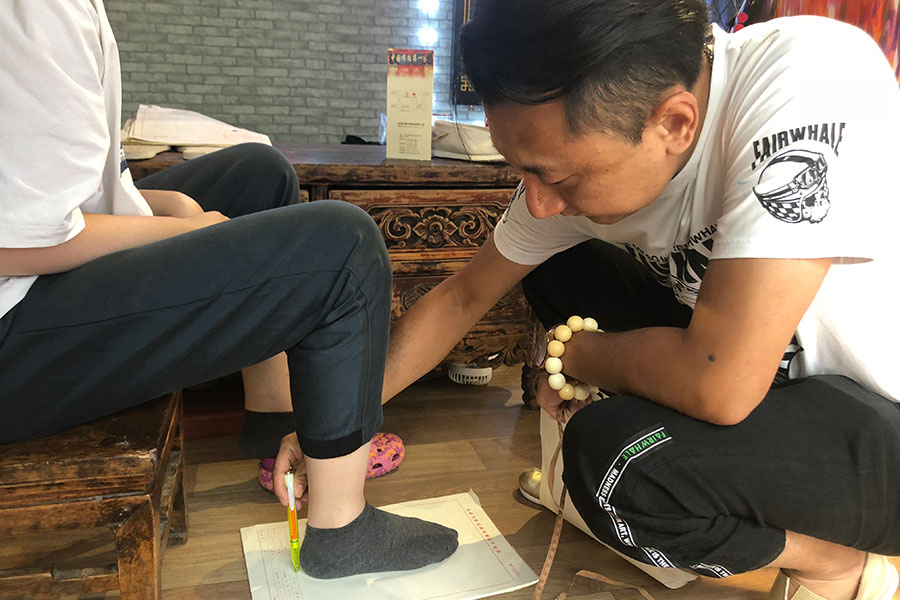
After image makeover, Neiliansheng's handmade product endears itself to younger consumers
Judge a man first by his shoes-so goes an old Beijing saying. Outdated it might be, but it shows that in the olden times, people of Beijing valued their shoes a great deal.
Cai Wenke, chief shoemaker of Neiliansheng, a time-honored Chinese brand best known for its "thousand-layered" shoes made of cotton, thinks many people in Beijing still value their shoes. He is out to fulfil their need for good shoes, having devoted more than a decade already to mastering the fine craft of shoemaking.
"I started as a salesman in Neiliansheng when I was in my early 20s, and I grew fond of the craft. Like, how do you even make the sole? I realized it takes at least 2,000 stitches, sometimes 4,200, to make one," said Cai. "I asked the manager to let me learn the craft, and I have been doing it ever since."
He said the making of a pair of Neiliansheng handmade cloth shoes involves over 100 processes, from drawing, draping to stitching.
"It requires one man to work eight hours for six days to make a pair," he said proudly, emphasizing that the process has not changed for over 100 years. "We need to preserve the tradition and heritage."
The "thousand-layered"-it is a gross exaggeration of the actual 30-40 layers-handmade cotton shoes were a luxury only the rich and the powerful could afford in the past. A pair of shoes that requires at least 48 hours of human labor to be made, was obviously beyond the grasp of the common man.
But machine-based manufacturing led to productivity boost, making many sought-after footwear brands affordable. This factor, coupled with Neiliansheng's fixation with black-and-white cotton shoes whose basic design hardly evolved for years, meant the brand was not among the fashion icons the younger generation of consumers craved.
Cai, however, thinks Neiliansheng has a bright future ahead, given that many traditional brands have reinvented themselves to be perceived as hipster favorites in recent years.
For instance, by co-designing with Japan's Mitsui & Co and Sweden's Happy Socks, Neiliangsheng has made its products more global, to be appealing for the young while preserving its core values and craftsmanship.
And so, in August, the 165-year-old Neiliansheng opened a pop-up shop in Sanlitun, Beijing's key commercial zone, to present its new avatar.
"It's mostly the young people who buy our shoes now," said Cai while measuring the feet size of a 20-year-old female consumer at the shop. The woman said she is set to go abroad for a while, so has been shopping for clothes and footwear. To wear a pair of Neiliansheng shoes that are unlikely to be found elsewhere seemed a brilliant idea to her.
As Cai demonstrated his shoemaking craft at the new store, passersby, suitably impressed, placed nearly 25 orders on two afternoons. "Now we are also heading toward being more fashionable, in design and form," he said. "We have co-designed products with intellectual property such as comics."
Cheng Xu, deputy general manager of the company, said he hoped such pop-up shops would dispel the stereotypes that people hold of traditional handcrafted brands.
According to a report in China Business Herald, since 2010, the brand saw steady growth in sales, with its annual revenue staying above 100 million yuan ($14.58 million).
To encourage time-honored brands such as Neiliansheng to reinvent themselves and withstand competition from modern, technologically superior manufacturers, a number of ministries, including the Ministry of Commerce, released a guideline last year to promote their crafts, products and technologies unique to China.
The unique products, exquisite skills and service concepts have been passed down from generation to generation. They are the carriers of the craftsman spirit of China and are of huge significance to the economy, local brands and cultural values, the guideline stated.
According to the Ministry of Commerce's research, 1,128 companies are regarded as traditional Chinese brands. Their average age is 140 years.
"At least 40 percent of the traditional brands are developing well. Half of them are maintaining a stable performance, while 10 percent are facing trouble," said Fang Aiqing, a former vice-minister.
As per official data, 788 traditional brands surveyed by the ministry earned a total revenue of over 9 trillion yuan in 2017, up 6 percent year-on-year, while their collective profit grew by 20 percent to 765.8 billion yuan.


















