



Japan tests China's red line in S China Sea









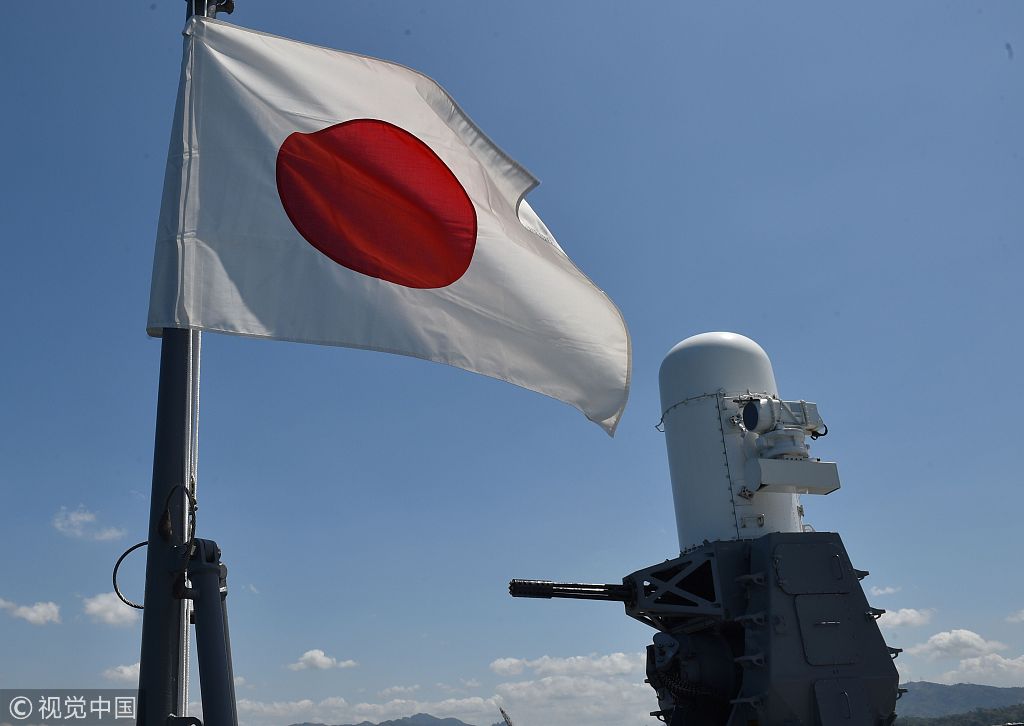
When Japan sent on Sept 13 its submarine Kuroshio to the South China Sea for a covert drill with the country's the helicopter carrier Kaga and two other destroyers, it was testing one of China's red lines.
It was the first exercise for the Kuroshio in the region.
On Sept 17, Japan's defense ministry made public the anti-submarine drill. Maritime Self-Defense Force Chief of Staff Yutaka Murakawa called the sea area vitally important for Japan. The drill was supposed to sharpen the submarine’s capabilities to approach vessels without being detected.
The drill was held within the nine-dash line, the boundary of an area in which China claims jurisdiction. The Japanese navy had previously conducted anti-submarine drills only in sea areas around Japan.
In an interview with The New York Times, Narushige Michishita, director of the Security and International Studies Program at the National Graduate Institute for Policy Studies in Tokyo, said Japan is sending "a signal that China cannot just do whatever it wants to do and get away with it".
Also, the Kuroshio, with a crew of 80, started a five-day port call at Vietnam's Cam Ranh Bay on Sept 17. It was the first call by a Japanese submarine at the strategic naval base that faces the South China Sea since World War II.
Japan has been trying to make its presence in the South China Sea alone or along with the US navy in recent years. Japan and the United States have had bilateral exercises in the South China Sea since 2015.
In 2017, Japan sent its Izumo helicopter destroyer to the South China Sea and the Indian Ocean for a three-month tour in its biggest show of naval force in the region since World War II. Military officers from the 10-member Association of Southeast Asian Nations bloc boarded the Izumo.
JS Ise, a Hyūga-class helicopter destroyer displacing 13,950 standard tons, joined the US Carl Vinson Strike Group for a bilateral naval exercise in the South China Sea in March. The drill included practicing joint anti-submarine warfare operations and replenishment-at-sea with the USS Carl Vinson.
Since his return to office in 2012, Japanese Prime Minister Shinzo Abe has visited all 10 countries of Association of Southeast Asian Nations, and other senior Japanese government officials also made frequent trips to the region. Those trips saw a deepening of Japan's defense relations with Southeast Asian states.
In November 2016, Japan unveiled its first defense initiative for the ASEAN, known as the Vientiane Vision. Under the initiative, Japan will have defense collaboration with ASEAN as a whole rather than with select Southeast Asian states, be it increased resources targeted at boosting coast guard capacity-building as well as wider maritime law enforcement training in collaboration with other external partners like the United States.
While Japan, along with the United States and other allies, wants to poke its nose in the South China Sea, China and ASEAN states have been making progress in efforts to reduce tensions.
In early August, foreign ministers from China and ASEAN announced they had agreed on a negotiating text for the code of conduct for the South China Sea. Singapore's Foreign Minister Vivian Balakrishnan deemed the draft a "major achievement". And Foreign Minister Wang Yi also called it a major development. Without any disturbances from outside, Wang said, negotiations on the code of conduct will accelerate.
Chinese and ASEAN leaders will meet in November, with many people expecting that a final version of the code of conduct would be agreed on.
The China-ASEAN Maritime Exercise, initially proposed by China, was held on Aug 2-3 in the form of a tabletop exercise at Singapore's Changi Naval Base, in which more than 40 naval and other military officers from the 11 countries joined in. It was a precursor to an actual drill in October.
Improving their ties, China and ASEAN have been facilitating communications and building trust to deal with crises and contingencies.
The interference from countries outside the region will complicate the situation and increase the chances for contingences or clashes in the South China Sea. The Japanese submarine is a wrong signal.
The author is China Daily Tokyo bureau chief.





