



Ecological civilization: A discourse in the making









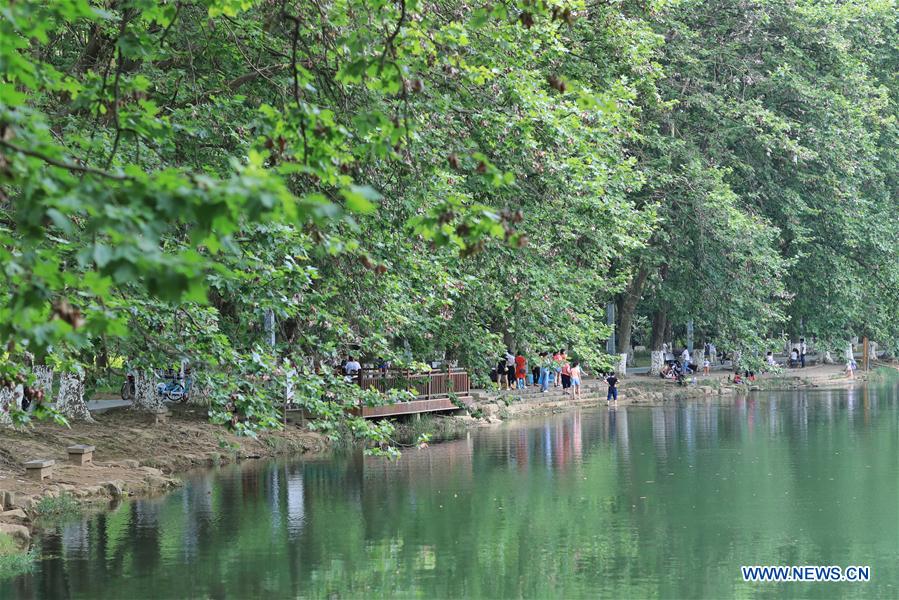
The majority of governments, international organizations, multinational corporations and social groups in the world recognize that human activities have had a significant impact on the natural environment. Compared to other narratives about environmental governance laden with promises and perils, China’s ecological civilization has received extensive international attention and increasingly been praised in public debates.
Internally, China secures 43 percent of the world's 10.3 million clean energy jobs. The state’s unflinching determination to win the battle against pollution is manifested by a wide range of momentous structural innovations and institutionalizations. According to a recent report prepared by the Frankfurt School-UNEP Collaborating Centre for Climate & Sustainable Energy Finance, China's new investment in renewable energy in 2017 reached $126.6 billion, a figure accounting for 45 percent of the global contribution which is also three times more than that of the US ($40.5 billion).
Externally, overseas scholars from renowned universities and think tanks have published a series of academic works and comments on ecological civilization. John B. Cobb Jr., a member of the American Academy of Arts and Sciences, said China would have the potential to take the lead in building up a global ecological civilization when interviewed by Xinhua News Agency. The think tank Toward Ecological Civilization was also founded under his auspices.
Professor John Bellamy Foster at the University of Oregon believes that China's advocacy of building an ecological civilization is not a product of Western-style ecological modernism, and capital-centered development models will not sustain the environment. Professor Mette Halskov Hansen at the University of Oslo, Norway, and her co-authors have recently had their ecological civilization research published in China Quarterly, a top journal in the field of China studies.
Don Henry, a professor at Melbourne Sustainable Society Institute, pointed out that China's official ecological civilization narrative has promoted a new economic strategy that focuses on ecological upgrading and inclusive development. Marco Lambertini, director-general of the World Wildlife Fund International, held that the “ecological red line” policy is very good, but it needs a sound governance system to implement it and ensure strict enforcement incentives.
Professor Daniel K. Gardner of Smith College observes that China is using clean energy and green technology to get rid of dependence on fossil fuels, and investing billions of dollars in renewable energy projects around the world. Both are worth learning for the United States. Erik Solheim, UN undersecretary-general and executive director of UNEP, believes that China's Belt and Road Initiative is important in addressing global climate change and enabling energy cooperation for countries along the route.
Given the diversified global environmental context, the spreading of the notion of ecological civilization admittedly faces challenges.
First, the supporting scholarly infrastructure, which includes but is not limited to theoretical definition and data compilation, remains weak. According to a report by the China Council for International Cooperation on Environment and Development, versatile professionals with ecological and discursive expertise are still relatively in need at both governmental and civil organizations.
Moreover, the current exploration of constructing an ecological civilization appears to be dominated by governmental narratives, whose perspective can be enriched by adding more concrete stories of the experiences of the ordinary people. To answer questions such as whether China can sustain its development in an eco-friendly manner, the interaction between China's ecological institutions and the global mechanism for curbing pollutions needs to be further strengthened.
With the combined efforts of public and private environmental stakeholders proceeding, China may enhance the appeal of ecological civilization worldwide and contribute more to global ecological security.
Bearing the common environmental concern in mind, many countries now have their own conceptions of ecological governance. However, these ideational “nodes” have rarely been bridged to form a compatible narrative due to various political and economic reasons.
In the process of integrating development strategy with that of countries along the modern Silk Road and related partner states, strengthening the ecological orientation of investment should become a priority. Ecological civilization can act as an umbrella term to connect individual discursive nodes in different countries to form an international network of ecological narratives.
Second, more intellectual products should be supplied as a result of cross-fertilization of ideas by experts with different training backgrounds. It is necessary to cultivate interdisciplinary talents by encouraging cross-institutional and multilingual cooperation, and increase the supply of intellectual products spanning databases, governance indicators, research handbooks and popular reading materials on global ecological civilization.
The research results of the professional think tanks such as the China Council for International Cooperation on Environment and Development and the Global Energy Internet Development Cooperation have supplemented the governmental narrative and played a significant role in transnational communication.
Third, two types of narratives -- academic and popularized -- should be distinguished. Media platforms, such as China-US Focus in Hong Kong and China Dialogue in London, employ bilingual reports to unravel China's ecological and environmental achievements and shortcomings. Their operational mechanism deserves further study.
Corresponding to academic and public narratives, research manuals and popular reading materials that summarize research results in a certain field have been welcomed in the market. For example, the Handbook series and What Everyone Needs to Know series, both published by Oxford University Press, cover a wide range of subjects and spark new interest in relevant issues.
Finally, the construction of ecological civilization is closely related to the world economy, global justice, international security, energy politics and climate diplomacy. China should actively take part in the global stakes laid out in the Paris Agreement and help shape the contemporary ecological narrative which is consistent with both its own environmental interest and international ecological security.
The author is a assistant professor at the Central Compilation and Translation Bureau.





