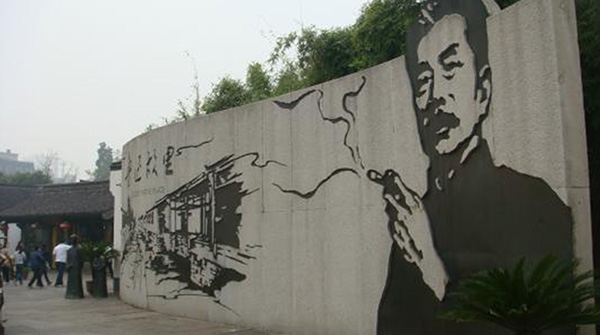
Shaoxing,Zhejiang province, China
It might be said that the great writers of each generation have not only succeeded in evoking a place or people, but also found a distinctive, previously unheard voice through which to do so. From Dostoevsky to F. Scott Fitzgerald, the universally recognized writers of each nation have cultivated a style that is precisely their own, while seemingly representative of the national tenor.
Chinese essayist and translator Lu Xun (1881-1936), and a leading figure in the New Culture Movement of the 1920s and conversations on reform in China, surely sits amid that tradition of voice creators. His essays, including "Medicine” and ”Kongyij” and the various literary journals he helped edit and publish illuminated Chinese society through characters that everyone could recognize but no one had before seen on the page. Kong Yiji tells the story of an aging, ridiculed scholar who fails the xiucai examination and is mocked in the local bar, and implicitly criticizes the futility of an exam-based education system and human indifference. In "An Incident", we confront a passenger whose rickshaw collides with a pedestrian. The passenger must ask, "When do my social obligations to others begin?"
Lu Xun's style is defined by intricate symbolism and philosophical questions as they arose in quotidian life—“how should one act as a friend, a citizen, a partner”—which themselves are interwoven with often melancholic existential realities and historical commentary on China as it moved away from an imperial system and into years of reform and revolution.
These were facets of Lu Xun’s voice, but perhaps the most important was that he often wrote in vernacular Chinese. For centuries, literary writing was composed in the classical style, or wenyanwen, which followed a different syntactical structure from spoken speech and held myriad references to ancient tropes and stories, making it illegible for someone without formal training.