



In-home nursing rises as latest medical care trend









Govt stepping in to resolve issues ranging from credentials to safety
China's national health authority is planning to launch pilot projects to improve online nursing care platforms, a senior health official said.
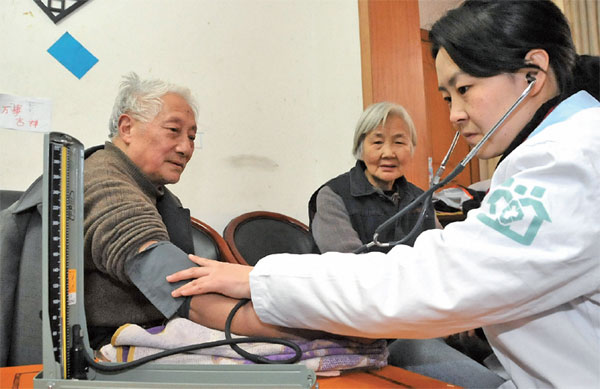
As one of the latest manifestations of the digital economy, nursing care platforms enable users to place orders and make appointments to receive services at home. Services offered include injections, removing stitches, blood collection, urinary catheterization, post-surgery care and postnatal care for babies and their mothers. The price is usually several times higher than that charged by hospitals.
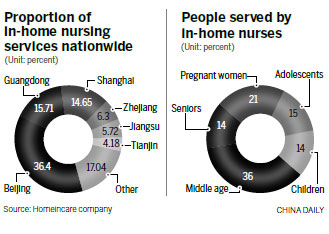
Over the past couple of years, more than 10 platforms have emerged, and some of them have developed rapidly. For example, the app Homeincare, which was launched in December 2015 and billed itself as the first of its kind in China, said some 50,000 nurses from 233 cities and regions have registered and provided services to more than 100,000 users.
In response to doubts in some quarters about the platforms' legitimacy and safety risks, Jiao Yahui, deputy chief of medical administration and supervision for the National Health Commission, said the commission had noted the concerns and "planned to launch pilot projects to track down and solve problems".
Concerns include the qualifications of nurses, assumption of legal responsibility in cases of error or accident and the safety of nurses, Jiao said.
Apps such as Homeincare allow not only nurses working at hospitals and other recognized organizations to register as service providers but also those who hold nursing credentials but are not employed by any organization.
"The professional level and capability of the nurses registered on these online platforms could vary greatly," said Lin Xingfeng, director of the nursing department at the Second Hospital of Shandong University.
"Improper nursing care might lead to medical mistakes, but there are no regulations to define who's responsible," he said.
If a mistake is made at a recognized organization, such as a hospital or eldercare facility, the organization will be the one to handle the situation. But online platforms have no terms to regulate who takes over if an accident happens, he said.
A nurse in Jinan, who only gave his surname, Li, told China Daily that he is always careful when providing services outside a hospital.
"Some users might ask me to remove stitches. But even if I see only a slight possibility that the wound could become infected, I will cancel the order and not do it," said Li, who registered on a platform in May.
He admitted the pay is high - removing stitches for patients at home would pay 90 yuan while the platform keeps 40 yuan - but the earnings are not worth the risk, he said.
There are also worries about nurses' safety, he said, even though most nursing care platforms offer insurance for both nurses and users.
Li said he has not heard of any female nurse who has registered with an online platform.
Xie Qi, chief operating officer of Homeincare, said the company has so far not received any report about a medical mishap, but he admitted that there are risks.
"Around 30 percent of orders were canceled because the prescriptions users uploaded to Homeincare were not verified or because no nurses accepted the orders - especially in remote areas," he said, adding that the company will explore ways to cooperate with medical organizations and borrow experience from home-care providers in the United States.
In China, health authorities have been pushing for reforms in the medical sector, one of which aims to let people get nursing care not just at hospitals but also in their own community or home.
According to the National Health Commission, 40 million elderly people in China - where the average age is climbing rapidly - are disabled or partially disabled. The number is expected to reach 97.5 million by 2050. Yet there were only 3.8 million nurses nationwide in 2017, which is insufficient to care for the country's elderly, Jiao of the National Health Commission said earlier.
"Based on our national conditions, nursing care provided by organizations should not be our main future direction. The main bodies offering care for the elderly should mostly be communities and home-care options, with priority given to communities," she said.
Measures taken have included an online system launched in late June to enable people to access basic information about medical professionals, including nurses, and check their educational background and certificates.
Beijing, Tianjin and Guangdong have allowed nurses to practice at more than one organization. In the past, they were limited to just one.


- Sour soup from Guizhou makes a splash overseas too
- Scientists discover 'baby star clusters', offering new evidence for star formation
- Chinese scientists provide new perspective on origin of target asteroid of Tianwen 2 mission
- New construction land rule seeks to curb urban sprawl
- Hong Kong formulating 1st Five-Year plan at full speed: chief executive
- China enhances guarantee of natural resource elements for major projects





