


Waking up to a masterpiece









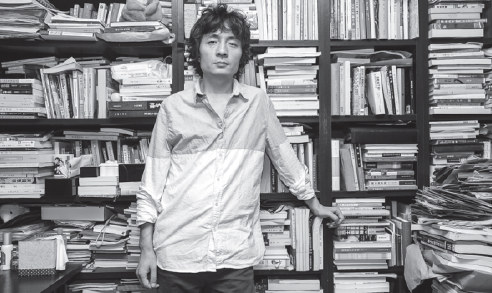
Born as Ai Guozhu in a village in Ruichang, Jiangxi province in 1976, A Yi is the second son in a family of five children. His mother and grandfather were amazed to find little Ai's talent for using metaphor at a very young age, and it soon became his star turn when he performed in front of relatives.
"That enhanced my tendency to use metaphors and to connect one thing to another as I read. Metaphors and story ideas keep exploding in my mind," he says.
In writing his novel, he had to force himself to use fewer metaphors, and even delete two-thirds of those he had already created "to stop readers getting annoyed".
A mediocre high school student, A Yi took enrolled at a local police academy in 1994. Over the next three years, he seldom listened to his teachers and practiced writing during class, usually finishing a short story by the end of each lesson.
He later became a policeman in the small town of Hongyi, Jiangxi province. Except for writing love letters - which he never mailed - to a woman he was secretly in love with, and witnessing the occasional murder or mass disturbance, A Yi soon grew bored of idling away his afternoons.
A year later, he was transferred to a county-level police bureau to write speeches for senior officers and investigation reports. In the evenings, he killed time with his colleagues playing mahjong.
During one all-night game, the moment dawned on him where he could see his "endless boring life stretching ahead".
In 2002, the 26-year-old Ai Guozhu quit his job and moved to Zhengzhou, Henan province, to work as a sports editor at a newspaper. The experience of being a policeman, the secret love and the days of boredom all soon became the inspiration for his writing.
After spending time in Shanghai and Guangzhou, he finally settled in Beijing. In 2009, he published his first book Hui Gu Shi (Gray Stories), a collection of short stories.
Two years later, his second book, Niao, Kan Jian Wo Le (The Bird, Saw Me), came out. His later novella, Xia Mian Wo Gai Gan Xie Shenme (Perfect Crime), has been translated into English, French, Italian, Swedish, Spanish, Russian and Arabic.
A fan of writers like Albert Camus, Raymond Carver and Franz Kafka, in his early short stories and novellas A Yi tried to imitate their allegorical and minimalist styles to suppress tension and emotion under a veneer of cold, simple words.
In 2011, the urban population in China surpassed that of rural areas for the first time.
A Yi realized that the China of his parents' generation and the traditional rural way of life were disappearing. He finally grasped onto the notion as the ideal subject for his first novel.
By creating the protagonist of Ai Hongyang, a local villain in the small village of Aiwan, and depicting his hastily organized but overly elaborate - and farcically formal - funeral, A Yi tries to show how quickly the rural way life in China that had existed for centuries is vanishing.
However, he found it impossible to employ his old style of allegory and minimalism in the novel. Instead, in the first three chapters of his first draft, he tried to pour his thinking onto the page without the use of punctuation - much in the style Faulkner depicted life in Yoknapatawpha county in the Deep South.
"It was impossible to create complicated characters like Shuizhi using the old style. She was the pretentious and insidious widow of Ai Hongyang. With few words and simple sentences, it would be hard to show the complexity of - or to reconstruct the image of - the rural area and its spirit," he says.
Worried that he might have "taken too big a stride" with his fluid writing style, he gave up on it.
A Yi also tried to record the customs of these rural areas, and went to great lengths to list all the popular local brands of snacks, drinks and dishes on offer at the funeral.
"Local brands will soon become outdated in rural areas. If nobody records them, they will soon be forgotten altogether."