



High speed rail – China’s great modern masterpiece









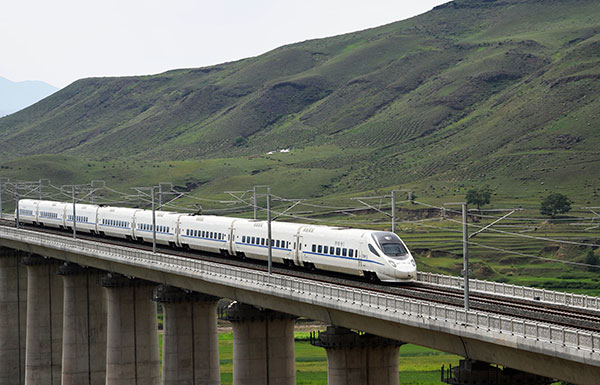
Recently I had a business trip to Tianjin. I left my Beijing apartment and walked half a block to the subway station. A dozen or so stops later I reached the high speed rail station, and after two minutes of security I picked up my tickets, which I had purchased on my phone while on the subway, and strolled the 60 or so paces to the terminal and hopped on the train. Twenty-eight minutes later I was in the center of beautiful coastal Tianjin, where I could enjoy a leisurely walk along the riverside towards my hotel. The whole experience took no more than a few hours, with no cars, no airports, no credit cards and no long lines, just my smart phone, a few US dollars and comfortable walking shoes. In most places in the developed world, this experience simply doesn’t exist. But China is different.
I still gaze in wonder at the magnificent architectural and engineering wonders that are China’s high speed rail stations every time I enter them: Massive structures that handle waves of humanity every day and connect hundreds of millions of people and goods in a manner and scale unimaginable in most countries. If China’s infrastructure projects are the crown of its modern economic miracle, then I believe its high speed rail system is the crown jewel.
China’s high speed rail network is a result and powerful symbol of not only China’s modern economic miracle achieved through ‘reform and opening up’, but also of China’s unique developmental political-economic system. Much of the success China has achieved in its world leading infrastructure development, from high speed rail to superhighways to urban subways, to some of the world’s largest airports, is the result of its mixed market driven/central state planned system. It's a system that has been criticised as cumbersome, wasteful and unsustainable by many western commentators over the years.
In the spirit of ‘mozheshitouguohe’, or ‘crossing the river by feeling out the stones’, China carefully and methodically liberalised sectors of the economy to domestic and international competition, increasing productivity and innovation and driving down costs, fuelling healthy growth and sustainable employment and consumption. However, China has maintained that there are some projects of national significance that cannot be produced through reliance on free markets and private actors. Major infrastructure projects are needed to maintain growth, increase capacity and connectivity in critical urban clusters and sustain future development for downstream liberalised industries that rely on infrastructure.
Building infrastructure on the scale that China has involves incredible cost, costs that can take decades to recover and thus would be unlikely taken on by private firms. The current state of public transport infrastructure in many developed western countries evidences this fact. Only the state has the ability to marshal the resources needed to develop these systems. China’s political-economic system allows for the state to plan and implement large-scale, long-term projects that look decades into the future. China’s incredible high-speed rail system is a testament to the strength of this system.
The great rejuvenation of the Chinese nation under the leadership of Xi Jinping requires world class infrastructure, investment in new technology and vision. China’s high speed rail showcases all these features and it is no surprise, therefore, that the newest high speed train models are called fuxing, rejuvenation.
The incredible success of China’s modern high speed rail network is not just a symbol of a new and innovative China, or a sign of economic strength. It is also a powerful reminder that though the economic system of the People’s Republic of China is different to Western liberal democracies, it boosts advantages over those systems in some regards, and practically for developing economies.
The author is a lawyer from New Zealand.






