The rise of intangibles









New technologies promise huge scalability for businesses in such industries as marketing, branding and software design, says economist Jonathan Haskel. Andrew Moody reports.
Jonathan Haskel says the rise in property values in China's cities is more down to the rise of the intangible economy than the attraction of tangible assets such as apartments and houses.
The economist says the factor behind the rise is people moving to the city to work in intangible industries such as marketing, branding and software design.
"The types of people who benefit from the intangible economy are going to move into the cities. This has the effect of raising house prices, because property is in short supply," he says.
"The other thing it does is increase the social divide between city and rural dwellers, whose properties don't tend to rise in value. People there are not doing these innovative new jobs and they get left behind."
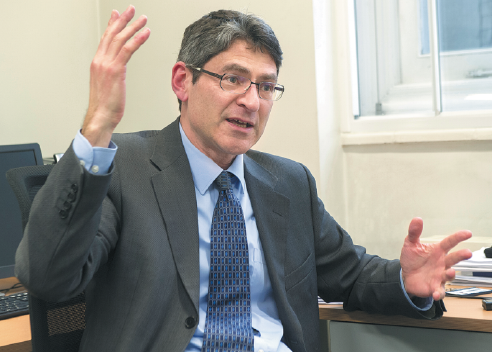
Haskel, 54, who was speaking in the office of the futuristic campus of the Imperial College Business School in London, where he is professor of economics, is the author with Stian Westlake of a new book, Capitalism Without Capital, that has attracted significant attention in the West.
"I think with this book, we are pushing at an open door. People know from their everyday experience that business is just getting more and more intangible. It is, however, something that is more or less ignored in company accounts and also in national (government) accounts," he says.
"There is just this disconnect between the sort of narrative people talk about in terms of a company's success and what they read when they get the hard numbers."
He cites as examples a company like Microsoft, where it is almost impossible to measure the value of investment in software development unless it has been developed and sold, and also airlines.
"Monarch Airlines, Britain's fifth-biggest airline, went bankrupt in October. It was an example of the fact that very few airlines own anything tangible anymore. Within 10 days, most of the fleet had been returned to the people who were leasing it," he says.
"What there was then was this huge long argument about the intangible assets of the business, which in Monarch's case were the landing slots at Britain's congested airports."
The book's ideas challenge those of the French economist Thomas Piketty, who in his best-selling book Capital in the Twenty-First Century argued that it is those with assets who have been getting consistently wealthier over the past 250 years, compared with those without assets.
"The reason why we disagree with Piketty is that he takes a slightly old-fashioned Marxist view that the marquis or the duke can make a lot of money by just hording their assets," he says.
"The problem with this is that not all assets are rising. House prices may be going up in the cities, where the intangible workers move to, but if you, for example, took a place like Gateshead (a northeastern English town), which has been quite run down, they are not really rising at all. The same can be said also of Donald Trump's so-called Rust Belt."
Haskel says the intangible economy is not new, with most of the assets of companies like Coca-Cola, which dates back to the late 19th century, being intangible.
"The value of the company is in its actual recipe, the branding, the marketing and the advertising, whereas the bottling and the delivery are on the tangible side. Of course, the recipe cannot be patented because then everyone would know what the formula was."
The economist says new technologies have made it possible for intangible businesses to have huge scalability.
"If I am Bob's Taxis and want to carry more taxi passengers, I have to order more taxis, whereas if I am Uber or Didi, I don't have to make that kind of investment to scale up," he says.