New bridge set to energize bay area economy and culture









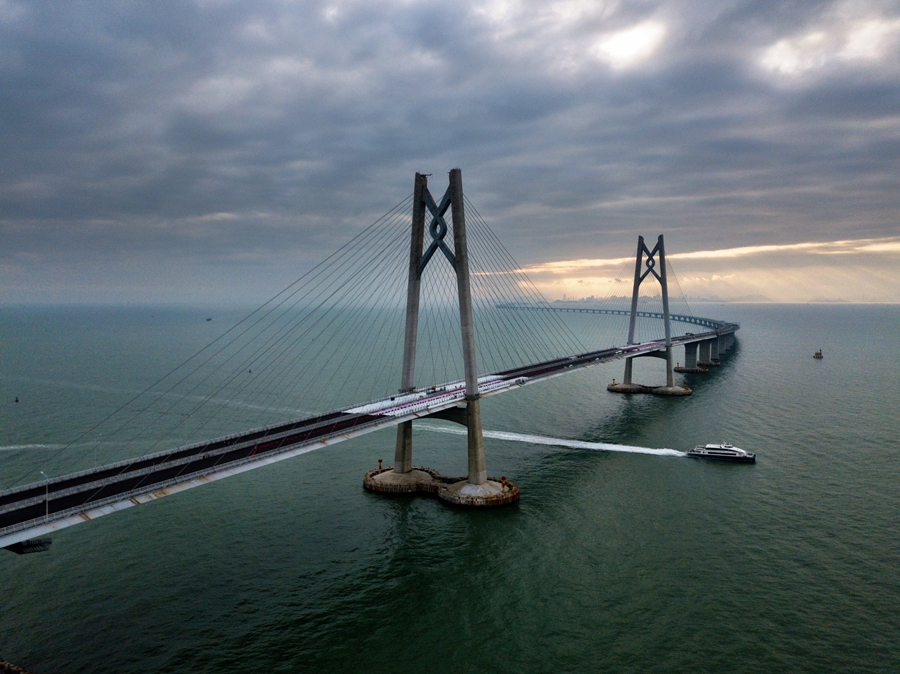
The 55-kilometer-long structure will connect Hong Kong on the east of the Pearl River Delta with Macao and Zhuhai on the west, as He Shusi reports.
The opening of the Hong Kong-Zhuhai-Macao Bridge, the first road link to span the Pearl River Estuary, will provide a crucial boost to the development of the Guangdong-Hong Kong-Macao Greater Bay Area, according to experts.
They said the improved connectivity will release the vitality of the regional economy and merge Hong Kong and Macao, two special administrative regions, with China's overall development.
The bridge will drive the expansion of the economy in the Greater Bay Area, according to Gordon Wu Yingsheung, chairman of Hopewell Holdings, an infrastructure and property developer in Hong Kong.
In 1983, Wu spotted the great potential of the manufacturing sector in the Pearl River Delta. Realizing that Hong Kong's limited market meant its development would be reliant on neighboring Guangdong province, he initiated the idea of building the link across the estuary.
At present, the economic development of cities on the eastern side of the delta, including Shenzhen and Huizhou, is surging, while west bank cities such as Zhuhai and Jiangmen lag behind.
Trade hub
By connecting Hong Kong with highways in Guangdong that run all the way to the Guangxi Zhuang autonomous region and the southwestern province of Yunnan, the bridge will consolidate the city's role as an international trading and air transportation hub, and accelerate development in Guangdong's western areas.
"If there is no developed transportation infrastructure, the economy will never soar," Wu told China Daily in an exclusive interview.
Hu Xijie, former deputy minister of transport, echoed Wu's opinion. He said the bridge will improve communication within the Bay Area, especially between cities in Guangdong, and with Hong Kong and Macao.
Hu believed the power of the bridge will be highlighted as the SARs further integrate into the country.
"The bridge is vital to the overall development of the Bay Area politically, economically and culturally," he said.
Construction of the world's longest sea-spanning project began at the end of 2009, and the 55-kilometer-long bridge-island-tunnel complex will connect Hong Kong on the east side of the delta with Macao and Zhuhai on the west.
The bridge cost about 120 billion yuan ($18.8 billion). Once operational, it will cut the journey time between Hong Kong and Zhuhai by car from four hours to less than 60 minutes.
City cluster
According to Lin Ming, chief engineer of the bridge's island and tunnel project, the bridge will promote the development of more urban areas within the Bay Area because China's urbanization process relies mainly on the coastal regions.
"The delta in Guangdong is the perfect location for metropolises. Sustainable development in the delta will require more roads-the more, the better," he said.
He dismissed criticism that the bridge will only benefit Hong Kong, and said it will help the long-term integration of the entire Bay Area.
"If you only see the benefits to Hong Kong, you may only be talking about a 20-year time scale. If you foresee the future in 30 to 50 years, the bridge will be for the Bay Area as a whole. The further you look at the development, the better you will understand the significance of the bridge," he said.
Su Quanke, chief engineer of the Hong Kong-Zhuhai-Macao Bridge Authority, the operator of the bridge, said the structure will play a major role in China's development blueprint.
He added that at least five bridges will be needed to connect the western and eastern sides of the estuary and cope with the increase in traffic as the local economy expands.
"As the first physical connection across the Bay Area, the bridge will bring greater economic power to the region," he said.
The bridge will also straddle the differences between social systems.
The 14 years of preparatory work and construction of the structure have provided a wealth of cross-governmental experience, as the HZMB Authority cooperated with the governments of Guangdong, Hong Kong and Macao, according to Su, who said that experience could be spread across the entire Bay Area.
Su was a newly elected member of the 13th National Committee of the Chinese People's Political Consultative Conference at the recent two sessions.
He said the authority, as the first entity jointly founded by the mainland administration and the two Special Administrative Regions, could play a bigger role in future infrastructure projects in the Bay Area as a result of its experience of cross-governmental management and cooperation.
Lau Ching-kwong, a prominent bridge expert in Hong Kong, said the project is a testament to the positive exchanges in civil engineering and management concepts between Hong Kong, Macao and the mainland.
"The bridge has promoted cross-cultural and cross-background communication in the Bay Area," said Lau, a fellow of the Hong Kong Academy of Engineering Science and a former director of the city's Civil Engineering and Development Department.
Su Yi, head of the Working Group on Cross-boundary Policy Research for the HZMB Authority, hoped the cooperation between Hong Kong, Macao and Guangdong for the construction of HZMB will also boost the Bay Area's "software".
Greater exchanges
The key lies in knowing how to merge the region, according to Su Yi.
"The bridge will open a door for people from different political systems to have a greater exchange of thoughts and coordination," he said.
He added that the project will also promote similar exchanges and communication across the Bay Area in terms of capital, trade and policies, and winning people's hearts.
The blueprint for the Bay Area is part of the national development strategy put forward in the Government Work Report delivered by Premier Li Keqiang in March last year.
Similar to the San Francisco Bay Area in the United States, the strategy is designed to merge cities in the Pearl River Delta-such as Hong Kong, Macao, Guangzhou, Shenzhen, Zhuhai, Foshan, Zhongshan, Dongguan, Huizhou, Jiangmen and Zhaoqing-into an integrated economic and business hub.
The bridge, one of the most important national infrastructure projects in recent years in the Bay Area, is expected to open in the second quarter, possibly in May or June, according to people familiar with the matter who spoke to China Daily in January.
Contact the writer at heshusi@chinadailyhk.com
- Macao border zone of Hong Kong-Zhuhai-Macao Bridge officially handed over to Macao
- Development plan for Greater Bay Area to be unveiled
- China to unveil plan for Guangdong-Hong Kong-Macao coordinated development
- Major tunnel of HK-Zhuhai-Macao Bridge completed
- Port projects of world's longest sea bridge completed



- Half a century of friendship: China's role in shaping Bangladesh's talents
- International Circus Festival brings top performers to Cangzhou
- Tianwen 2 spacecraft halfway to target asteroid
- Vibrant China during holiday: Hitting the road
- International Cartoon and Illustration Exhibition on a Community with a Shared Future for Humanity 2025 Announcement
- Bringing revolutionary history back to life