



Green tax will help clear the air









Companies that cause pollution face new national procedures in move to protect environment
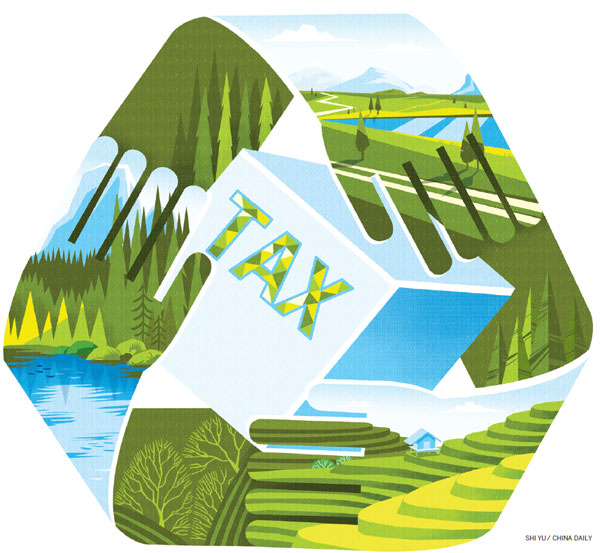
As the new year starts, companies, especially those in the chemical and energy sector, are facing a new type of green tax: firms that cause pollution will be taxed under a uniform set of national rules instead of the previous fees collected at the local level.
The enforcement regulations of China's Environmental Protection Tax Law, which require businesses and public institutions to be taxed for directly discharging pollutants in China and maritime areas under its jurisdiction, was signed by Premier Li Keqiang and released on Dec 30. Designing of the law was started in 2014, and was passed by the National People's Congress Standing Committee in 2016.
The law, which went into effect on Jan 1, marks China's first tax aimed at ecological preservation and environmental protection.
Wang Jin'nan, head of the Chinese Academy for Environmental Planning under the Ministry of Environmental Protection, said legalization of the tax will have a major impact on greening the country's tax system.
"This is the first special tax targeting environmental protection, and it will also have an important effect on green production and consumption," Wang said.
It was made clear that all environment tax revenues raised from polluting firms will go to local level governments, as an attempt to encourage local authorities to enforce environmental protection measures.
The new tax replaces the previous pollutant discharge fees, which the government started to collect from enterprises in 1979. The central government takes a 10 percent share of the amount collected from all companies.
Under the new law, companies will pay taxes ranging from 350 yuan ($54) to 11,200 yuan per month for noise, according to decibel levels. It also set rates of 1.2 yuan on stipulated quantities of air pollutants, 1.4 yuan on water pollutants and a range of five to 1,000 yuan for each metric ton of solid waste.
For instance, polluters will pay 1.2 yuan for an emission of 0.95 kilograms of sulfur dioxide and 1.4 yuan for one kilogram of chemical oxygen demand. Carbon dioxide is not included in the levying list.
For companies, even though only a few days have passed since the new tax law was implemented, what the "fee-to-tax" shift means to them most is a fairer business environment.
Zhang, manager of a papermaking factory in Anhui province who is unwilling to have his full name published, said: "This means the amount of money being charged will be unified and we will be able to see clearer regulation."
Under a new program, local authorities have the mandate to set their own tax rates on firms emitting air and water pollutants from January, according to the State Council. Regions including Beijing, Shanghai and Hebei have already published their tax program.
Lu Zhengwei, chief economist at Industrial Bank Co, said the "feeto-tax" shift makes the government environmental campaign more powerful.
"Pollutant discharge fees, in many cases, can be quite flexible for local governments to levy," he said.
"Sometimes, when local governments want to attract more businesses, they can make their own decision not to levy such fees to enterprises as a way to attract them to develop in local areas to create more revenue. There were previously loopholes that local governments could use when charging pollutant fees to exempt companies who contribute greatly to local fiscal revenues."
He said though changing from fee to tax, the amount of money levied on companies will not be increased much.
Li Zuojun, professor from the Development Research Center of the State Council, said putting environment tax income into local governments is a common practice in many other countries.
"It will make the country's taxation system more efficient, with collection carried out in a more transparent and well-structured way," Li said.
"At the same time, environmental conditions, production capabilities and industrial structure vary from one place to another, the pressure facing local governments in different areas are also different. Giving all tax revenue to local government is also a financial incentive to encourage their effort in environmental protection."
While most experts applauded the new tax, Li also pointed out that the next step is to make sure that money levied for the purpose of environmental protection will be spent on environmental protection as well.
"The government has been able to come out with certain measures in regulating compliant use of tax revenue. Yet as environmental tax is a new type of tax and its revenue will all go into local level governments, sound and appropriate regulation is particularly needed to make sure such revenue will be spent in the right places," Li stressed.
He said this may take time to explore, and may face setbacks, but this will also help the new tax to improve in its implementation.


- Researchers discover natural hydrogen trapped in Qinghai-Tibet Plateau
- Yunnan researchers reveal Cambrian vertebrates may have had 'four eyes'
- Scientists uncover response mechanisms of alpine plants phenology to climate change
- Beautiful Tianjin episode 2 showcases city's natural landscapes
- Over 1,500 criminal suspects repatriated from Myanmar
- Gang Aoping: Justice is served for Jimmy Lai












