



Moon's China visit key to peace amid tensions









The Jilin Daily has dedicated a full page in its Wednesday edition to advise readers how to take protective measures in case of a nuclear explosion, attracting wide public attention. Although the advisory may be part of a routine national defense education program, it highlights the rising tensions on the Korean Peninsula and its possible consequences.
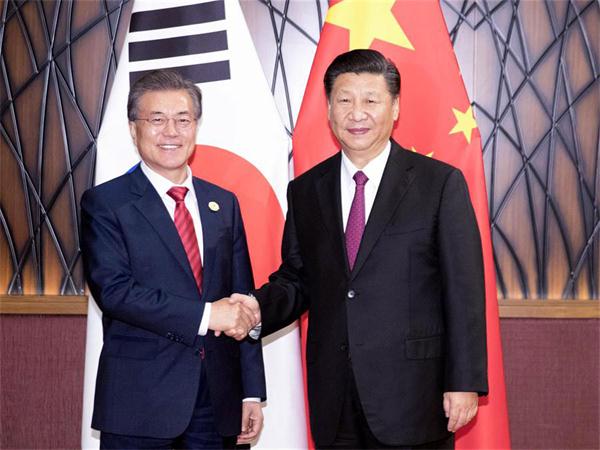
In these critical times, a healthy relationship between China and the Republic of Korea is crucial for restoring peace on the peninsula as well as the region. We hope ROK President Moon Jae-in's visit to China next week will lay the foundation for that much-needed healthy and fruitful bilateral relationship.
Indeed, the relationship between China and the ROK has improved after the two countries agreed on how to deal with the Terminal High Altitude Area Defense antimissile system and some other issues. Still, bilateral relations are far from perfect, and the respective choices the two sides make will have an impact not only on the situation in Northeast Asia but also China-US relations.
The ROK, of late, has been more dependent on the US because of the Democratic People's Republic of Korea's nuclear program that, in a major way, is responsible for raising tensions on the peninsula. The DPRK's latest intercontinental ballistic missile launch shows that the country could possibly fire a nuclear weapon that could strike anywhere in the United States. And the possibility of "unintentional war" can't be ruled out because of US President Donald Trump's "risky game" with the DPRK.
Worse, despite there being more than enough reason for Beijing and Seoul to further improve bilateral ties, the US' Asia-Pacific strategy of building a free and open "Indo-Pacific" with the active help of Japan, Australia and India, which many observers say is aimed at curbing China's peaceful rise, poses a new challenge to and raises uncertainties for China-ROK relations.
If Seoul becomes an active participant in Washington's "Indo-Pacific" strategy, it will strengthen the US-Japan-ROK alliance. But in so doing, it will pose a challenge to China, as well as worsen the situation in Northeast Asia, which may possibly lead to conflicts with China.
The strategy of the US is to force China to put pressure beyond its capacity on the DPRK to halt its nuclear program. Given this fact, China's neighboring countries that are US allies have to decide what is in their national interest: helping the US fulfill its self-centered strategic "Indo-Pacific" goals or cooperating with China to restore peace in the region and further develop their economies.
The challenge for China is how to improve relations with its neighbors and expose the so-called restrictions imposed by the US' "Indo-Pacific" strategy. Perhaps China should develop political and economic relations separately with its neighbors, through deepened cooperation.
Since a confrontation between the US and China will also harm the ROK, the latter ought to make greater efforts to settle the DPRK nuclear issue through talks, rather than aggression, as the US wants.
China and the ROK should use the THAAD issue to reflect on bilateral ties. The THAAD system poses a threat to China's security and compromises the ROK's position when it comes to resolving the Korean Peninsula nuclear issue. But since the US stands to benefit from the dispute between China and the ROK-because it can use it to strengthen its alliances with the ROK and Japan and thus increase its influence on the peninsula-it doesn't want to see an improvement in Beijing-Seoul ties, even if it means Pyongyang using it as an excuse to conduct more nuclear and missile tests.
The best way to resolve the Korean Peninsula nuclear issue is to involve all the parties concerned, including the US and China, to find a peaceful resolution through talks. Therefore, Beijing and Seoul should realize the importance of healthy bilateral ties in maintaining peace and stability on the peninsula, as well as the Asia-Pacific region. A prosperous and stable Asia-Pacific will improve not only China-ROK ties but also international relations.
The author is head of International Politics Institute at Yanbian University, Jilin province.





