



Transport Ministry to double new energy service vehicles goal









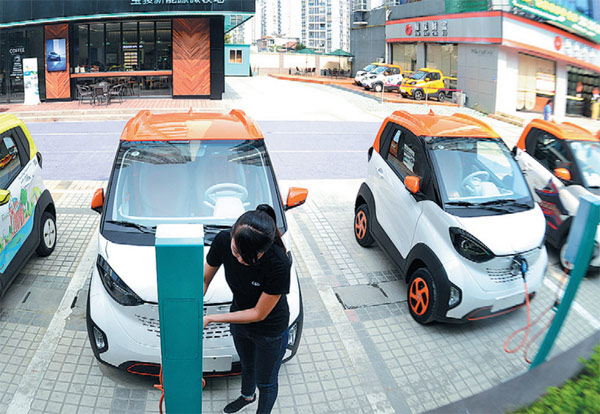 |
| A woman charges a new energy vehicle in Liuzhou, Guangxi Zhang autonomous region. Strengthened supervision is urged to meet the rapid development of new energy vehicles in China. [Photo by Li Hanchi/For China Daily] |
The Ministry of Transport has suggested doubling a key new energy target for the transportation sector, as the current goal could be met three years ahead of schedule, according to Cai Tuanjie, a ministry official.
China is expected to meet its 2020 goal of having 300,000 new energy service vehicles on the road by the end of this year, according to Cai. So, the ministry is looking to raise the target to 600,000 vehicles, he said.
Transportation is one of the key sectors in which the country is promoting the use of new energy vehicles, including buses, sanitation vehicles, taxis and logistics vehicles, according to a plan submitted by the ministry and approved by the State Council in 2014.
In that plan, the Transport Ministry required more than 200,000 new energy buses, 50,000 new energy taxis and 50,000 new energy logistics vehicles to be in service by the end of 2020.
Nationally, 30 percent of new and replaced buses, taxis and logistics vehicles are required to be new energy vehicles, while the proportion is set at 35 percent for Beijing, Tianjin and Hebei province.
The transportation sector will not encounter big challenges in achieving the doubled target, according to Ron Zheng, Shanghai-based partner of the German firm Roland Berger Strategy Consultants. But, the critical factors will lie in the government's concrete supporting measures and the construction of charging facilities, he said in a telephone interview.
"The policy will determine the development direction. The target of 600,000 units is surely achievable and executable when calculating at the current growth rate," Zheng said.
He added, "The major growth source is new energy buses because the policy clearly promotes the replacement of conventionally powered buses."
In its June E-mobility Index report, Roland Berger said China will dominate both the new energy market and the industry in the foreseeable future, because the key growth drivers include government subsidies and simpler licensing procedures.
Zheng noted that while subsidies aid the development of new energy vehicles, strengthened supervision is required to prevent abuse of the system.
"It's about who supervises, how to supervise, and even the punishments, to avoid the type of fraud we've seen in the past," he added.
China recently penalized a number of new energy vehicle manufacturers for fraudulently claiming subsidies. As of February, the authorities had successfully retrieved subsidies and imposed penalties of 2.3 billion yuan ($333.5 million) in total.
An electric bus-maker that was fined, Suzhou King Long, has now become eligible again for the central government's subsidies. Its parent company, Xiamen King Long, said that after passing an inspection, electric buses produced after Aug 21 comply with regulations.
Minister of Industry and Information Technology Miao Wei said in February the government will improve existing policies and strengthen the regulation of subsidies offered to carmakers.
Battery packs
Cai at the Ministry of Transport said related agencies will work together to boost the quality and stability of electric motors, controls and batteries.
Zheng at Roland Berger said, "Chinese local manufacturers will not face big problems in adapting their products for commercial vehicles and buses."
"Local power battery production and demands are well developed," Zheng added.
Roland Berger found that locally made lithium-ion cells are used in more than 90 percent of the vehicles produced by Chinese manufacturers.
China rolled out a total of 350,000 new energy vehicles in 2016. Double-digit sales growth continued in the first eight months of 2017, with a total of 320,000 vehicles produced, up 30.2 percent year-on-year, data from the China Association of Automobile Manufacturers showed.
More than 1 million new energy cars were registered by the end of August, according to the Traffic Management Bureau of the Public Security Ministry.
Xin Guobin, vice-minister of industry and information technology, said that the country is reviewing the timetable for phasing out the production and sale of fossil fuel cars.




















