



Xiongan's success hinges on prudence









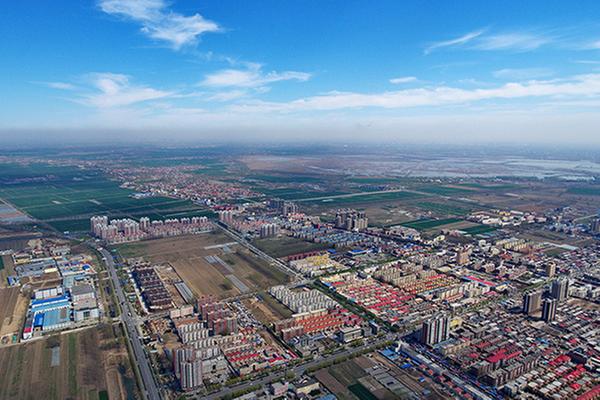 |
| Aerial photo taken on April 1, 2017 shows Anxin county, North China's Hebei province.[Photo/Xinhua] |
 |
| Xuan Xiaowei [Photo/China Daily] |
The millennium plan to establish Xiongan New Area spanning Xiongxian, Rongcheng and Anxin counties, which was announced on April 1, reflects Xi's new thinking on how to relocate the non-capital functions out of Beijing and further integrate the development of Beijing, Tianjin and Hebei province. And the decision to build a Beijing-Xiongan high-speed railway just three months after that announcement can be regarded as the first step to further promote the construction of Xiongan and move non-capital functions out of Beijing.
Unlike Beijing's Tongzhou district, the capital's administrative subcenter, Xiongan is expected to be an "innovation high ground" featuring smart industries, instead of just a manufacturing cluster or a real estate project.
In other words, what Xiongan aspires to follow is either Zhongguancun, a technology hub for startups in Beijing, or Shenzhen, a symbol of China's reform and opening-up, or even the Silicon Valley in the United States. Expected to be innovation-driven, environmentally friendly and a salutary residential zone, the new area will be marked by better city planning, more affordable housing and a sophisticated transport network facilitating the integration of Beijing, Tianjin and Hebei.
However, the construction of Xiongan New Area hinges on consistent and huge investments that can amount to hundreds of billions of yuan per year, which warrant extra financial assistance from the central government. And since Xiongan is essentially under the jurisdiction of Hebei's provincial government, the later will also have to contribute funds to help develop the new area.
But the question is: Does Hebei have the financial capability to contribute its share of the funds?
A routine practice for many local governments that have Xiongan-like development zones under their jurisdiction is to start infrastructure work by borrowing funds and make profits from the sales of land-use rights and/or high property prices. Authorities have made it clear that the use of land and the property market in Xiongan will be tightly controlled. In such a case, enlisting the help of private capital would be worth it, although it could make sustainable funding a tricky affair.
Expanding the local talent pool will not be easy either. An innovation-driven economy relies on the concentration of talents and technologies as much as it does on flexible management. Unlike Shenzhen, Xiongan has many administrative strings attached to it, which could hold it back in the race for building intellectual prowess. Competitors such as Beijing-based Zhongguancun aside, simply relocating scientific research institutes and universities to Xiongan does not guarantee that they will retain their innovative character.
For Xiongan-like zones, sustainable development and vibrant communities are a necessity. Successful precedents suggest new development zones are more likely to prosper after accommodating local government organs, which would also help them improve infrastructure, and offer more business opportunities and better transportation services.
Xiongan, on the other hand, will absorb only some of Beijing's non-capital functions that carry little administrative power and, hence, limited potential to make the new area prosper. These questions should be answered and latent risks assessed in advance as the Xiongan project proceeds. Designed to serve long-term development goals, Xiongan needs careful planning and proactive thinking to boost regional integration. But then we need patience and prudence to scientifically advance the construction of Xiongan.
The author is a researcher at the Development Research Center of the State Council.





