



Trump signals shift in US foreign policy









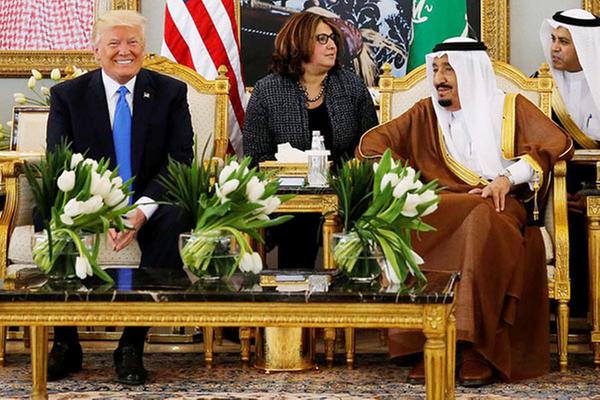 |
| Saudi Arabia's King Salman bin Abdulaziz Al Saud (2-R) welcomes US President Donald Trump (L) with a coffee ceremony in the Royal Terminal after he arrived aboard Air Force One at King Khalid International Airport in Riyadh, Saudi Arabia May 20, 2017. [Photo/Agencies] |
US President Donald Trump began his first overseas trip in Saudi Arabia, where he got a royal welcome on Saturday in stark contrast to the low-key reception offered to his predecessor Barack Obama last year, perhaps owing to the latter's nuclear agreement with Iran in 2015.
Trump could claim the fanfare with which he received in Riyadh reflects the success of his "Buy American, Hire American" policy, especially because he has cut a deal to sell US-made military arms to Saudi Arabia, worth $110 billion effective immediately and up to $350 billion over 10 years. Trump's ultimate aim is to promote US exports. He chose Saudi Arabia as his first stop on his first foreign trip as US president because the Saudis have both the motivation and the resources to buy US products and were intent on revitalizing Washington-Riyadh ties after the cooling of bilateral relations during Obama's presidency.
Despite his instable temperament, Trump, it has to be assumed, is also a politician. He wanted to assert his leadership qualities by meeting some Middle East leaders to urge them to fight terrorism, and to mobilize opposition against Iran so that it cannot develop missile and nuclear weapons technology. In this regard, Trump should appreciate the Saudi King's role as the host of an "Arab-American" meeting, which set the stage for him to sell his vision of forming a NATO-like organization in the Middle East.
First, the massive arms sale is expected to generate tens of thousands of jobs in the United States. And it's deals like this that Trump has tried to pursue. Since he has to honor his campaign promise of "making America great again" despite the US' slow growth rate, he has chosen his own way of doing it given the challenges facing him at home, including his recent controversial meeting with Russian officials in the Oval Office.
Many politicians and political observers have also criticized Trump's handling of international issues. His order to launch a Tomahawk missile attack on a Syrian air force base has soured US-Russia relations. And in the four months of his presidency, US relations with NATO, Germany and Australia have suffered some setbacks. That's why his visit to Saudi Arabia acquired greater significance.
Second, Trump's visit to the Middle East has a purpose: to bring Arab countries together to further his anti-terrorist mission. Since 2001, Washington has been trying without success to prevent the emergence of terrorists and new terrorist groups in the region, in order to safeguard its interests and prevent terrorist attacks on the US.
In response to the Sept 11, 2001, attacks, then US president George W. Bush declared a "war on terror", as part of which the US-led allied forces invaded Iraq in 2003 and toppled the Saddam Hussein government, creating a security vacuum and a fertile soil for breeding terrorists. And Obama's decision to withdraw US troops from Iraq helped the Islamic State group gain immense strength and wreak havoc in the region, especially in Syria and Iraq.
By meeting leaders from the Middle East, Trump tried to drive home the point that the "war on terror" is to protect all countries from terrorist attacks. He reportedly also asked the Saudi leadership to set up a regional security organization modeled on NATO.
But since Teheran is wary of such developments and the Trump administration has been talking about pulling out of the Iran deal, newly re-elected Iranian President Hassan Rouhani could come up with a strong response, which would further worsen the already tense situation in the Middle East.
From Saudi Arabia, Trump flew to Israel, where again he received a warm welcome on Monday. He even drove to the West Bank on Tuesday to meet Palestine President Mahmoud Abbas. These developments show the US foreign policy is shifting toward the Middle East, which traditionally had been the case before Obama implemented his "rebalancing to Asia" strategy.
The author is a professor at and associate dean of the Institute of International Studies, Fudan University.





