



Trump's tax reform raises many questions









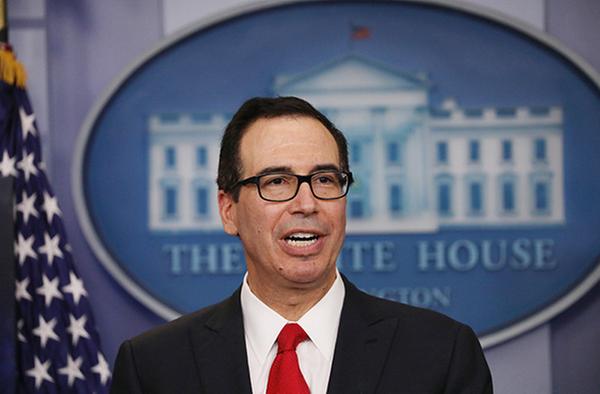 |
| US Secretary of the Treasury Steven Mnuchin discusses the Trump administration's tax reform proposal in the White House briefing room in Washington, US, April 26, 2017. [Photo/Agencies] |
News reports on US President Donald Trump's tax reform have focused on the tax cuts, but there is more to it than just that. Trump's tax reform can be divided into four main parts: tax cuts, simplification of the taxation process, fixing the loopholes in the system, and a shift toward a territorial tax system that taxes domestic income but not foreign income.
Trump's tax plan is aimed at cutting taxes while keeping the revenue neutral by fixing the loopholes in the system and shifting to a territorial, even a border adjustment tax, system.
Since Trump's tax reform is aimed at revitalizing the United States economy, the business community has welcomed it. The business community's positive response was reflected in the Goldman Sachs index, which dramatically increased after Trump made the announcement.
Those opposed to Trump's plan say the tax reform would increase the federal budget deficit. While the US Tax Policy Center estimates the tax reform would increase the federal debt by $7 trillion in the first decade, the Center for a Responsible Federal Budget says it would raise the deficit by about $5.5 trillion over the same period.
But the government's fiscal loss will benefit non-government players. And even if a couple of trillions of that money trickle back into businesses, the US economy will benefit greatly.
The impact of Trump's tax reform will be felt far beyond the US; it is already having a spillover effect on other countries. If the US really reduces corporate tax to 15 percent, it will be lower than even those in low-tax economies. And lower tax rates will attract more enterprises, capital and high-end talent to the US.
But to offset the impact of Trump's tax reform, other economies may also reduce their tax rates, leading to a global race to cut taxes, as happened in 1981 when former US president Ronald Reagan reduced the tax rates.
China is also promoting tax reform, but that is more to meet its own economic development needs. In the Government Work Report, Premier Li Keqiang has said the reduction in tax and fees this year will add up to 1 trillion yuan ($145.1 billion). On April 19, China's State Council executive meeting announced that companies' tax burden will be reduced by more than 380 billion yuan and fees by 200 billion yuan this year. China's tax reform will boost enterprises' profits, a large percentage of which is expected to flow back into businesses and boost the economy.
Trump's tax reform plan has several problems. First, can Trump give a concrete shape to his tax reform framework? His reform plan, listed in points, is more of a wish list than an actual set of proposals. The details are still to be filled in. For example, it aims to subsidize childcare, which can be done in many ways. And the reform framework doesn't specify which one or ones the Trump administration has in mind.
Second, is Trump's plan permanent or temporary? Companies will make long-term investments and hire more workers only when they have a permanent plan to work on.
Third, when Trump decides to implement his tax reform plan, other countries will respond by cutting their taxes even more, which will make Trump's policy less attractive to investors, thus drying up investments and failing to boost the economy. So, the extent to which other countries cut their taxes will be a very important influencing factor.
Fourth, what is the balancing point between stimulating the economy and realizing social fairness? Many experts say Trump's tax plan will hurt low-income households the most. In October 2016, the Tax Policy Center estimated that Trump's plan will increase after-tax income for the top 1 percent US households by more than 14 percent compared with the less than 1 percent increase for the lowest quintile.
Trump's plan is not a solution to the social unfairness in the US, because it can propel economic growth only in the short term. The final version of Trump's tax reform plan depends on how well he and Capitol Hill weigh the pros and cons of tax cuts.
The author is a research fellow and director of the Division of American Economic Studies at the Institute of American Studies, China Institutes of Contemporary International Relations, and a visiting scholar at Harvard University.





