



Growing friendship provides food for thought









|
An expert walks past a sign on experimental farmland near the China-Kazakhstan border. Ren Qi / China Daily |
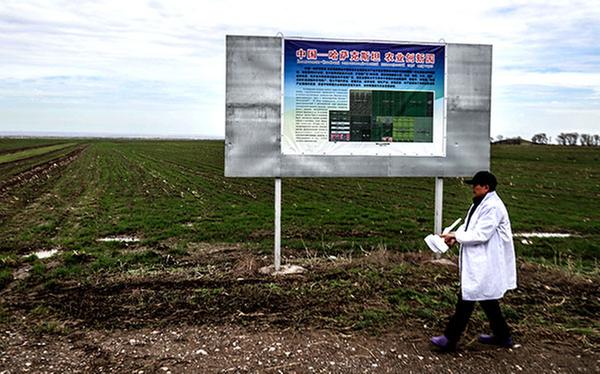
While energy remains the core of cooperation between China and Kazakhstan, the two nations have also cultivated agricultural links in recent years.
In a field near the western foot of Tianshan Mountain, which forms a natural border between the countries, wheat is being grown from Chinese seeds on 200 hectares of land.
Yangling Modern Agriculture Demonstration Park Development and Construction, a company in Shaanxi province, has been using the land to test crops since 2015, when it entered into a strategic cooperation partnership with the Kazakhstan International Integration Foundation.
"We've grown 27 different varieties in six main categories: wheat; corn; oilseed rape; soybeans; vegetables; and green seedlings," said Cui Weijun, assistant to Yangling's chairman. "We've also introduced new technology and seen highly positive results.
"We started a wheat-planting experiment in 2015, and our output now is 82.3 percent higher than that at local farms."
The pilot project is being carried out 70 kilometers from Almaty, the former Kazakh capital, which has a similar arid climate to Shaanxi in northwestern China, he added.
In addition to the high output, the cooperation has also created more than 50 jobs so far, according to Cui, who said the ratio of Kazakh employees to Chinese is 4-to-1, while more than half of the management team was hired locally.
Kazakhstan, the ninth-largest country in the world, has seven climate belts, which indicates huge potential for a range of agricultural projects. Cui expects to see cooperation expanded and more jobs created for both Chinese and Kazakhs.
The testing ground is rented by a joint venture established by Yangling and the integration foundation, which was founded in 1994.
Sergey Tereshchenko, the former prime minister of Kazakhstan, is the foundation's chairman. Foreign companies are prohibited from owning or renting land in Kazakhstan.
Manshuk Zhexembekova, who rents farmland to the venture, said the operation has gone smoothly, adding that as the experiment moves into its third year, the Chinese company is trying something different.
"For instance, the agricultural experts from Yangling wanted to build a greenhouse on the field to raise the number of crop varieties," she said.
Bai Yuhao works in the foundation's office in Shaanxi. He regularly flies to Almaty with experts from Yangling to handle relations with Kazakh farmers and government officials.
He said some local experts have been surprised by the yields the project has produced: "For example, we've been able to harvest 319 kg per mu (0.06 hectares) of No 5 wheat, while local wheat can only produce 175 kg per mu."
According to Bai, the average temperature in Kazakhstan is lower than in Shaanxi, but between noon and midnight the difference is much larger, so the Chinese seeds grow better in Almaty.
Yu Jianwei, a Yingling manager responsible for dry farming - cultivation without irrigation - said developing the business has been more difficult than anticipated. Most of the problems arise from the differences in laws in the two countries.
In addition to the rules on renting land, Yangling is unable to sell its crops in Kazakhstan because foreign seeds need at least three good harvests before they can be sold in the Kazakh market.
Therefore, the initial stage of the venture has been focused on introducing technology and training farmers, Yu said, adding that skills such as seeding and irrigation are not as advanced as in China, and most Kazakh farmers lack experience of handling modern farm machinery.
To convince the integration foundation to establish longer-term cooperation, Yangling has conducted planting tests to produce tangible results, and invited agriculture experts to join communications efforts and offer training.
Despite the difficulties, Yu sees great potential for agricultural cooperation between China and Kazakhstan as the Belt and Road Initiative develops.
"We started our project just two years ago, and Yangling is planning to bring more Chinese crops to our neighbor. I believe agricultural exchanges will hit higher levels as the two countries improve cooperation under the Belt and Road Initiative," he said.










