



THAAD can further complicate situation on Korean Peninsula









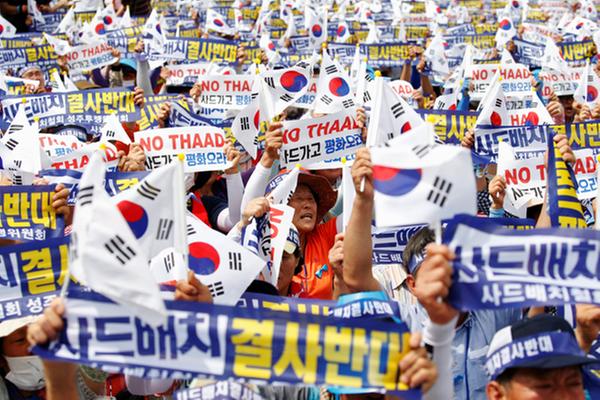 |
| File photo shows Seoungju residents chant slogans during a protest against the government's decision on deploying a US THAAD anti-missile defense unit in Seongju, in Seoul, South Korea, July 21, 2016. The banner reads "Desperately oppose deploying THAAD". [Photo/Agencies] |
International observers were surprised to see the Democratic People's Republic of Korea celebrate its Army Day on April 25 without any act of provocation, such as a missile launch. Yet the brief tranquility on the Korean Peninsula was short-lived as the DPRK reportedly test-fired a ballistic missile four days later.
Though the missile exploded shortly after liftoff, it still constituted a blatant violation of United Nations Security Council resolutions which forbid Pyongyang from taking such provocative actions. Given that Pyongyang has repeatedly resorted to acts of provocation and defied the international community's call to stop its ambitious nuclear and missile programs, its latest move deserves to be condemned by the international community in the strongest terms.
However, as tensions on the Korean Peninsula continue to escalate and the rival parties threaten each other with war rhetoric, it is necessary to ponder how the situation has worsened so fast and why it has tightened into such a complicated knot that it is almost difficult to undo it now.
It takes two to quarrel. This fact applies perfectly to the peninsula situation. In fact, recent years have seen rival sides fall into a vicious circle of provocation and retaliation.
The United States, despite claiming to have lost its "strategic patience", has shown overall restraint by playing down its calls for military action against Pyongyang. It has also stepped up efforts to communicate and cooperate with China to defuse the situation, reflecting its better understanding of how to restore peace and stability on the peninsula.
However, on April 26 the US Air Force conducted an unarmed intercontinental ballistic missile test with reportedly the DPRK as the imaginary enemy. It has also dispatched the aircraft carrier USS Carl Vinson toward the Korean Peninsula.
Pouring oil on fire, Washington and Seoul have also accelerated their efforts to deploy an advanced US missile defense system in the Republic of Korea despite strong opposition from Chinese and ROK citizens. On paper, the US' Terminal High Altitude Area Defense anti-missile system is intended to protect the ROK from missile attacks from the DPRK, but its surveillance capability is also bound to undermine the security interests of other countries, including China's.
A growing number of people in the ROK believe THAAD will only make their country unsafe, and they have staged massive protests against its deployment. Cheong Wooksik, director of the ROK-based Peace Network, recently published a book, Everything about THAAD, in which he says his country could be the biggest victim of deploying THAAD on its soil.
As far as Pyongyang is concerned, it has interpreted these military maneuverings as provocations and threats to its security. And since the DPRK responded to such threats with an even bigger threat, its failed missile launch on Saturday was not surprising.
On Sunday, officials in Seoul said Washington had reaffirmed it would bear the cost of deploying THAAD on ROK soil after US President Donald Trump declared a few days ago that Seoul should pay $1 billion for the anti-missile system.
Analysts say Pyongyang's missile launch on Saturday may have prompted the US to make a U-turn on the cost issue, paving the way for completing the THAAD deployment between July and September, much earlier than the original schedule of the end of the year.
In fact, parts of the THAAD battery were installed last week, and ROK defense officials said it already has an initial operational capability.
With the ROK presidential election round the corner, the US may want to make the deployment of THAAD an established fact so that whoever wins the election will have little room to delay the installation, let alone cancel it.
Such political calculation is dangerous because it can further complicate the already complex and volatile situation on the peninsula, and once the situation goes out of control, no party can emerge as a winner.
The author is a senior writer with China Daily. wanghui@chinadaily.com.cn





